TechVibeSpot earns a commission if you buy through links on this page. That never changes a verdict.
Dead batteries are the number one complaint about smart locks, and the DESLOC V150 Plus attacks that problem head-on with a perovskite solar panel that harvests power from ambient light as weak as 300 lux. Add 3D face recognition, a curved fingerprint reader, a 10,000 mAh removable battery, and a $229 early-bird price, and this Kickstarter campaign funded 100% within one hour. The catch: it ships from a crowdfunding campaign, skips Matter support, and buy-it-today rivals from Lockin already do solar charging well. This review breaks down the specs, the early hands-on reports, and whether you should pledge or pick an Amazon alternative instead.
Is the DESLOC V150 Plus worth buying? The DESLOC V150 Plus is worth backing at $229 if your entryway gets weak or indirect light, because its perovskite solar panel charges from roughly 300 lux where silicon panels stall. If you want Matter support or a lock you can buy today, the Lockin Veno Solar (from about $160 on Amazon) is the better choice.
How we assess: this review is based on manufacturer specs, official documentation, and verified owner reports, not hands-on testing.
Quick picks
DESLOC V150 Plus — for shaded porches and anyone tired of charging their lock; face + fingerprint unlock, ships August 2026.
See pledge options at DESLOC →
Lockin Veno Solar (Venoris) — the buy-today solar lock with Matter, Thread, and 3D face unlock; Tom’s Guide picks it over the DESLOC.
Check price on Amazon →
TEEHO TE001 (budget pick, under $100) — a simple keypad deadbolt with key backup that skips apps and batteries drama entirely; replace AAs once a year and move on.
Check price on Amazon →
Key takeaways
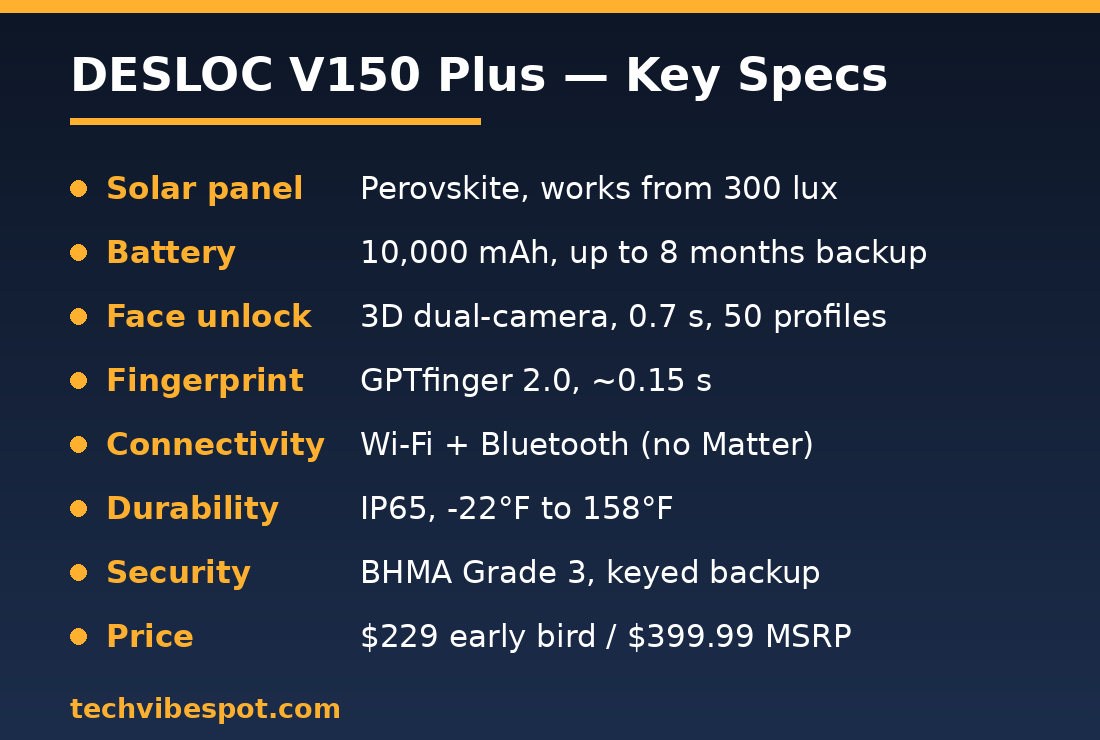
- The DESLOC V150 Plus is the first smart lock with a perovskite solar panel, rated to charge from light levels as low as 300 lux, roughly the brightness of a covered porch on an overcast day.
- Its 10,000 mAh removable battery runs up to 8 months with zero solar input, and a spare battery ships in the box.
- Unlock methods: 3D face recognition (0.7 s, 50 profiles), GPTfinger 2.0 fingerprint (~0.15 s), mechanical keys, app, and an optional $35 keypad.
- Early-bird pricing starts at $229 against a $399.99 planned MSRP; Tom’s Guide saw pledges as low as $169.
- There is no Matter or Thread support, only Wi-Fi and Bluetooth with Alexa and Google Assistant. Apple Home users should look at the Lockin Veno Solar instead.
- Tom’s Guide’s early hands-on found solar charging works (12% to 34% in a week of sun) but face unlock is slower than rivals.
- DESLOC is a new brand, but the hardware comes from DESMAN, a lock manufacturer operating since 2009 with 400+ patents.
- Shipping is planned for August 2026, and Kickstarter pledges are not purchases; if timing or risk bothers you, the Lockin Veno Solar and TEEHO TE001 are on Amazon now.
What Is the DESLOC V150 Plus?
The DESLOC V150 Plus is a solar-charging smart deadbolt for standard US and Canadian doors that launched on Kickstarter in June 2026 and hit 100% funding within its first hour. It replaces your existing deadbolt with a two-part system: an exterior unit carrying the perovskite solar panel, dual 3D face-recognition cameras, and a fingerprint reader, plus an interior unit holding the 10,000 mAh removable lithium battery and thumb turn. DESLOC is the consumer brand of DESMAN, a commercial lock maker founded in 2009 that claims more than 200 R&D engineers and 400+ patents, which matters when you are judging whether a crowdfunded lock will actually ship.
On paper the V150 Plus reads like a flagship: IP65 water and dust resistance, an operating range of -22°F to 158°F, BHMA Grade 3 certification, a 3,000 N deadbolt, anti-peep passcodes, and local (not cloud) storage of biometric data. Kickstarter named it a “Project We Love” in July 2026. Pledges started at $229 for the Super Early Bird tier, a claimed 42% discount on the $399.99 planned retail price, and every unit ships with a spare battery, two mechanical keys, and a magnetic door sensor that triggers instant auto-locking when the door closes. Retail units are planned to sell direct at $259.99, with shipping to backers slated for August 2026.
The pitch is simple: this is the lock you never charge. Whether that pitch holds up depends on one unusual piece of chemistry bolted to the front of your door.
How Does the Perovskite Solar Panel Actually Work?
The V150 Plus uses a perovskite solar cell instead of the silicon panels found on earlier solar locks, and DESLOC rates it to generate usable power from about 300 lux, roughly six times more efficient in low light than conventional silicon. For context, 300 lux is ordinary indoor office lighting; a shaded north-facing porch usually sits well above that during daylight. Silicon panels, by contrast, want direct sun and mostly idle in shade, which is exactly why solar locks have historically disappointed people whose doors face the wrong way.
That low-light claim is the whole reason this product exists, so treat it with appropriate care: it comes from DESLOC’s own materials, and no independent lab has published verification yet. What we do have is one early hands-on data point. Christian de Looper at Tom’s Guide ran a pre-release unit on a door receiving several hours of daily sun and watched the battery climb from 12% to 34% in one week. Charging while in daily use is the result that matters, and the V150 Plus delivered it in that test.
A proprietary battery-management system decides when the panel tops up the cell, and the DESLOC app graphs daily solar intake so you can see whether your door position is pulling enough light. If it never does, nothing breaks; the lock simply behaves like a conventional battery-powered deadbolt with an unusually large battery, and you recharge over USB-C or swap in the included spare.
How Long Does the Battery Last Without Sunlight?
DESLOC rates the 10,000 mAh lithium battery at up to 8 months with no solar input at all, based on 20 lock cycles per day; the product page states over six months of normal use. Either figure beats most battery smart locks, which typically run three to six months on four AA cells, and the V150 Plus doubles down by shipping a second 10,000 mAh battery in the box. Because the battery is removable, a swap takes seconds: pull the depleted cell, click in the charged spare, and charge the first one indoors over USB-C.
Three backstops protect you from a lockout. The exterior unit hides a USB-C port for emergency power from any power bank. Two mechanical keys operate a traditional cylinder, so the lock stays a lock even with the electronics dead. And the app pushes low-battery alerts long before you get near zero. High-traffic homes should discount the 8-month claim, since a household blowing past 20 openings a day will drain proportionally faster, but with solar assist covering part of the draw the practical answer for most doors is that you charge this lock rarely, and possibly never. If long battery life with a mechanical fallback is your main priority, our guide to the best smart locks with physical key backup covers more options.
How Fast Is the 3D Face Recognition, Really?
DESLOC quotes 0.7 seconds for face unlock, using a dual-camera 3D depth system with a 24 GHz radar that wakes the lock when someone approaches. The spec sheet is thorough: recognition from 15.7 to 39.4 inches away, users from 3.6 to 7.5 feet tall, up to 50 stored face profiles, infrared fill light for nighttime, a claimed false-acceptance rate under 0.001%, and liveness detection so a printed photo will not open your door. Biometric templates are encrypted and stored on the lock itself rather than in the cloud.
Early real-world reporting is less flattering than the spec sheet. Tom’s Guide found facial recognition “takes several seconds” on the pre-release firmware and called overall unlocking relatively slow compared with the best smart locks, while noting the fingerprint reader is the faster way in. That reader is DESLOC’s GPTfinger 2.0, a curved sensor rated at roughly 0.15 seconds with adaptive learning that improves matching for worn or dry prints over time, storing up to 50 fingerprints. In practice, expect the fingerprint to be your daily driver and face unlock to be the hands-full-of-groceries fallback. Firmware updates could close the speed gap before retail units ship, but judge the lock on what has been demonstrated: solar works, fingerprint is quick, face unlock needs patience.
Does the V150 Plus Work With Alexa, Google Home, or Matter?
The DESLOC V150 Plus works with Amazon Alexa and Google Assistant over its built-in Wi-Fi, but it does not support Matter, Thread, or Apple Home. No hub or gateway is required: the lock connects straight to 2.4 GHz Wi-Fi for remote control, with Bluetooth handling local connections when you are standing at the door. Through the DESLOC app you get remote lock and unlock, an access history showing who came and went, battery and solar-charging dashboards, timed auto-lock from 5 to 120 seconds (or instant, via the magnetic door sensor), and a landlord mode for managing rental access.
The Matter omission is this lock’s biggest strategic weakness in 2026. Its closest competitor, the Lockin Veno Solar, offers Wi-Fi, Thread, and full Matter support at a lower price, which plugs it into Apple Home, SmartThings, and Home Assistant without workarounds. If your house runs on HomeKit scenes or you want one standard tying every device together, the DESLOC will always sit slightly outside your ecosystem, controlled from its own app and voice assistants only. If you do not care about Matter, and plenty of buyers just want the door to open when they show up, the Wi-Fi-plus-app arrangement covers the essentials with no subscription fees. Readers wary of cloud dependence should see our guide to smart locks that work without Wi-Fi.
How Hard Is Installation, and Will It Fit Your Door?
Installation is a standard deadbolt replacement: remove your existing deadbolt, feed the connecting cable through the bore hole, screw the exterior and interior units together, and pair the lock in the app. Tom’s Guide called the process straightforward, and DESLOC designed the V150 Plus for standard North American door preps, so if a Kwikset or Schlage deadbolt fits your door today, this should too. The kit includes the deadbolt assembly, strike plates, mounting hardware, the magnetic door sensor, two keys, and both batteries.
Weather resistance is stronger than most rivals in this class. The exterior unit is IP65 rated against dust and water jets, and the operating range of -22°F to 158°F comfortably covers Minnesota winters and Arizona summers; DESLOC also cites 100 J impact testing on the housing. That IP65 rating beats the Lockin Veno Solar’s IP53, a meaningful gap for fully exposed doors that take driving rain. Renters should note this is a full deadbolt replacement, not a retrofit that leaves the exterior untouched, so you will need landlord approval, and you should keep the original hardware to reinstall when you move out. One height note from the spec sheet: the face cameras cover users from 3.6 feet tall, so small children will be unlocking with fingerprints or the optional keypad instead.
Is BHMA Grade 3 Secure Enough for a Front Door?
BHMA Grade 3 is the residential baseline, and the V150 Plus meets it, the same certification level carried by the Lockin Veno Solar and most consumer smart locks, including budget picks like the TEEHO TE001. Grade 3 certifies the lock survived standardized cycle testing, bolt-strength tests, and impact resistance appropriate for homes. It is not the Grade 1 rating of commercial hardware, and locks like the Aqara U400 (see our Aqara U400 review) that carry Grade 1 or 2 offer more physical resistance for the paranoid.
DESLOC’s numbers within that grade are solid: a deadbolt rated to 3,000 N of force, an 1,100 N cylinder, and 100 J impact testing. The digital side is arguably stronger than the physical side. Biometric data stays encrypted on the device, passcodes support anti-peep entry (bury your real code inside a longer random string), and the lock raises alerts for tampering, a door left ajar, and low battery. An anti-hijack function lets a household member trigger a silent alert with a designated finger or code. The honest framing: no consumer smart lock stops a determined burglar with a crowbar, and most US break-ins go through windows or unlocked doors anyway. Grade 3 with instant auto-lock, a door sensor, and an access log leaves the average home better protected than the spring-latch-and-habit arrangement it replaces.
How Does the DESLOC V150 Plus Compare to Locks You Can Buy Today?
The V150 Plus enters a category the Lockin Veno Solar already occupies at a lower price with broader smart-home support, so the comparison decides the purchase for most people. Here is how the DESLOC stacks up against its closest rival and two buy-today alternatives at other price points.
| Product | Price | Connectivity | Key backup | Best for | |
|---|---|---|---|---|---|
| DESLOC V150 Plus | $229 pledge / $259.99 retail | Wi-Fi + Bluetooth, Alexa & Google (no Matter) | Yes, 2 keys | Shaded doors that starve silicon panels | See at DESLOC |
| Lockin Veno Solar Face (Venoris) | From about $160 | Wi-Fi + Thread + Matter, Apple Home, Alexa, Google | Yes | Buying today with full Matter support | Check price |
| Lockin Veno Solar Palm | About $200 | Wi-Fi + Thread + Matter | Yes | Palm-vein unlock that works with gloves off, rain on | Check price |
| TEEHO TE001 | Under $100 | None (offline keypad) | Yes, 2 keys | Tight budgets, rentals, zero-app simplicity | Check price |
| Kwikset Aura Reach | Mid-range | Bluetooth + Wi-Fi | Yes | A mainstream brand with dealer support | Check price |
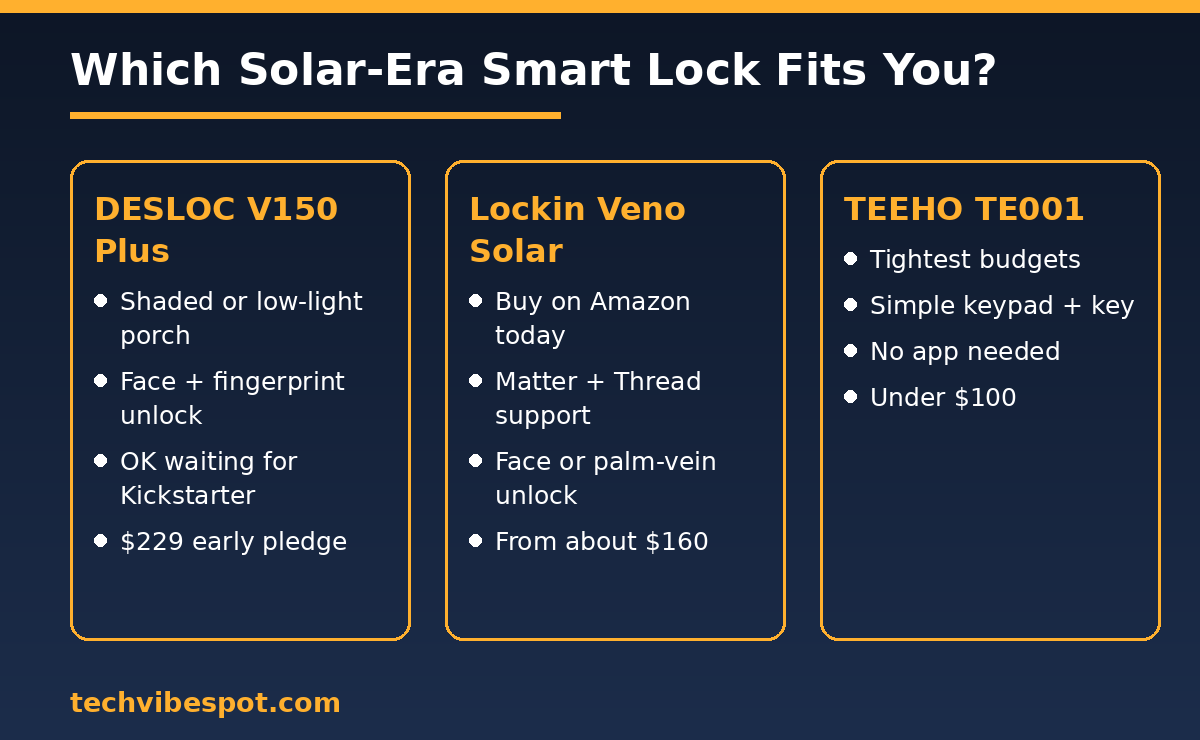
The pattern is clear. Choose the DESLOC for its perovskite low-light charging, superior IP65 weather sealing, and the included spare battery. Choose the Lockin Veno Solar for Matter, Apple Home, a lower price, and same-week delivery; Tom’s Guide reached the same conclusion, recommending the Lockin over the DESLOC until the latter gets refinement. Choose the TEEHO TE001 if the whole solar-biometric category feels like overkill; our best keypad deadbolts under $100 roundup explains why it keeps winning the budget slot. And if what you actually want is a video doorbell fused with a lock, the eufy FamiLock E40 we covered in our eufy FamiLock E40 review is the stronger fit.
Should You Back a Smart Lock on Kickstarter?
Backing the V150 Plus is a lower risk than the average hardware campaign, but it is still a pledge, not a purchase. Kickstarter’s terms are explicit that rewards are not guaranteed, refunds sit at the creator’s discretion, and delivery dates slip more often than not. Weigh three specific factors here. First, manufacturing depth: DESLOC’s parent DESMAN has built locks since 2009 at commercial scale, which removes the classic failure mode of a design studio discovering mass production the hard way. Second, momentum: the campaign funded fully within one hour and earned Kickstarter’s “Project We Love” badge, per the company’s announcement. Third, evidence: working pre-release units are already in reviewers’ hands, so this is not a render masquerading as a product.
Against that, this is DESLOC’s first consumer campaign, the perovskite efficiency claims remain manufacturer-verified only, and the door you are securing is not a gadget you can shrug about if firmware needs six months of maturing. The August 2026 ship date is one firmware-validation hiccup away from November. A sensible rule: back it if the $170 saving off MSRP and the low-light charging justify the wait and the small execution risk, and buy retail (or buy the Lockin) if your current lock needs replacing this month.
Buy This If / Skip This If
Buy the DESLOC V150 Plus if: your door sits under a porch roof or faces away from the sun, because the 300-lux perovskite panel is built for exactly that light; you want face and fingerprint unlock with biometrics stored locally; you live somewhere with hard winters, where the IP65 rating and -22°F floor outclass rivals; you value a removable battery with a spare in the box; and you are comfortable waiting for an August 2026 Kickstarter fulfillment at the $229 price.
Skip it if: you run Apple Home or want Matter and Thread, where the Lockin Veno Solar wins outright; you need a lock installed this week; unlock speed is your top priority, since early units show face recognition lag; you rent and cannot swap the deadbolt; or your budget stops under $100, where the TEEHO TE001 covers keyless entry for a third of the pledge price.
Verdict: A Real Innovation That Arrives Slightly Early
The DESLOC V150 Plus earns its attention. Perovskite solar is a material advance, not marketing paint, and it targets the one complaint every smart-lock owner shares: the door that dies. The 10,000 mAh removable battery with a bundled spare, IP65 sealing, wide temperature tolerance, and local biometric storage make this a thoughtfully engineered deadbolt, and DESMAN’s manufacturing history makes fulfillment more likely than the average campaign. The weaknesses are just as concrete: no Matter, sluggish face unlock on pre-release firmware, and a ship date you have to trust.
Our verdict: back it at $229 if low-light solar charging solves a real problem on your door and you can wait; otherwise buy the Lockin Veno Solar today and get Matter for less money. Either way, the era of the self-charging deadbolt has clearly arrived.
Check Lockin Veno Solar price on Amazon →
FAQ: DESLOC V150 Plus
Is DESLOC a legitimate company?
Yes. DESLOC is the consumer brand of DESMAN, a lock manufacturer operating since 2009 with a claimed 200+ R&D engineers and 400+ patents. The V150 Plus campaign funded 100% within one hour on Kickstarter and earned the platform’s “Project We Love” designation in July 2026.
Does the DESLOC V150 Plus work without Wi-Fi?
Yes. Face, fingerprint, passcode (with the optional keypad), and mechanical key unlocking all work with no internet connection, and Bluetooth handles at-the-door app control. Wi-Fi is only required for remote access, notifications, and voice assistants.
What happens if the battery dies completely?
You have three fallbacks: an emergency USB-C port on the exterior unit accepts power from any power bank, two mechanical keys operate the cylinder, and the box includes a second 10,000 mAh battery you can keep charged for an instant swap.
Does the solar panel need direct sunlight?
No. The perovskite panel is rated to charge from about 300 lux, which is typical shaded-porch or bright-indoor light. DESLOC claims roughly six times better low-light efficiency than silicon panels, though independent lab verification has not yet been published.
Does the V150 Plus support Apple HomeKit or Matter?
No. It supports Amazon Alexa and Google Assistant over built-in Wi-Fi, but has no Matter, Thread, or Apple Home support. Apple households should consider the Lockin Veno Solar, which includes Matter over Wi-Fi and Thread.
How many faces and fingerprints can it store?
Up to 50 face profiles and 50 fingerprints, with liveness detection to reject photos. All biometric data is encrypted and stored locally on the lock, not in the cloud.
Does the DESLOC V150 Plus work in extreme cold?
Yes, within its rating. The lock is specified for -22°F to 158°F (-30°C to 70°C) and 5% to 95% humidity, with IP65 water and dust protection, which covers nearly every inhabited climate in North America.
When does the DESLOC V150 Plus ship?
DESLOC plans to ship backer units in August 2026, with retail availability at $259.99 planned afterward through desloc.com. Kickstarter dates commonly slip, so treat the timeline as a target rather than a promise.
Sources: Tom’s Guide hands-on review · CNX Software · DESLOC official product page · Tom’s Guide Lockin Veno Solar review · PR Newswire
Prices checked August 5, 2026. Kickstarter pledge tiers and Amazon prices change frequently; confirm current pricing before buying.