TechVibeSpot earns a commission if you buy through links on this page. That never changes a verdict.
A solar-powered smart lock promises the one thing every keypad deadbolt owner eventually wants: never thinking about batteries again. In 2026 that promise finally has real hardware behind it. Lockin sells a palm-vein lock with a solar top-up panel on Amazon, Avia’s SolarPro keeps an Apple Home Key deadbolt fed for up to five years, Lockly builds a trickle-charge panel into a video lock, and DESLOC crowdfunded a deadbolt with a perovskite cell that harvests indoor-grade light. This guide compares all four, explains where solar genuinely helps and where it’s marketing, and includes one budget pick for anyone who realizes mid-read that a $70 keypad lock solves their actual problem.
How we assess: this review is based on manufacturer specs, official documentation, and verified owner reports, not hands-on testing.
What is the best solar-powered smart lock in 2026? The Lockin Veno with Solar Panel is the best solar-powered smart lock for most people in 2026. It pairs palm-vein and fingerprint unlocking with Wi-Fi, Matter support, and an IP65 shell for about $180. Apple Home users should get the Avia Deadbolt+ with SolarPro instead.
Quick picks
Best overall: Lockin Veno + Solar Panel (~$180)
For anyone who wants palm-vein unlocking, Matter, and a battery that tops itself up.
Check price on Amazon →
Best for Apple Home: Avia Deadbolt+ with SolarPro (~$299 bundle)
For iPhone households that unlock with a wrist tap and want up to five years between battery swaps.
Check price on Amazon →
Budget pick under $100: TEEHO TE001 (~$70, battery, not solar)
For anyone who just wants reliable keypad entry and is fine changing four AAs once a year.
Check price on Amazon →
Key takeaways
1. Solar panels on smart locks are trickle chargers, not power plants. They extend battery life from months to years; they don’t remove the battery.
2. The Lockin Veno + Solar Panel is the best all-rounder at about $180: palm vein, fingerprint, Wi-Fi, Matter, IP65.
3. Avia’s $43 SolarPro is the only add-on here that retrofits an existing lock, and only the Avia Deadbolt+.
4. DESLOC’s V150 Plus uses a perovskite cell that charges above 300 lux, so it works on shaded porches where silicon panels stall.
5. Every pick keeps a backup: physical key, USB-C port, or both. Never buy a solar lock without one.
Do solar-powered smart locks actually work?
Yes, solar-powered smart locks work, with one caveat: the panel supplements the battery rather than replacing it. Every lock in this guide stores power in a rechargeable cell, and the solar surface slows or reverses the drain. Tom’s Guide watched the DESLOC V150 Plus climb from 12% to 34% charge in one week on a door that got only a few hours of direct sun per day. On Lockin’s Veno Solar, the same publication recorded the battery gaining charge, 83% to 90%, across a week of normal family use.
The math favors the panel. A smart lock motor fires for a second or two per operation, and radios sip power between events. Even 20 lock cycles a day costs less energy than a few hours of decent light returns. That is why Avia can claim its SolarPro panel handles “up to 100 operations per day” in strong sunlight, and why DESLOC quotes eight months of runtime even if the panel never sees the sun again.
Where solar disappoints is expectation, not engineering. A north-facing door under a deep porch roof in December will not keep pace with a chatty Wi-Fi lock pinging the cloud all day. Buy solar to stretch charging intervals from months into years, not to pretend the battery doesn’t exist. If your door gets genuinely zero daylight, skip the category and pick something from our best smart locks under $100 guide instead, because you’d be paying a solar premium for a panel that idles.
How do the best solar smart locks compare at a glance?
| Lock | Price* | Connectivity | Key backup | Best for | |
|---|---|---|---|---|---|
| Lockin Veno + Solar Panel | ~$180 | Wi-Fi, Bluetooth, Matter | Physical key + USB-C | Most doors, most budgets | Check price |
| Avia Deadbolt+ SolarPro | ~$299 bundle | Thread, Bluetooth (Apple Home) | Physical key + key fobs | iPhone and Apple Watch homes | Check price |
| Lockly Vision Elite | ~$400 | Wi-Fi (hub included) | Physical key + micro-USB | Video doorbell + lock in one | Check price |
| DESLOC V150 Plus | from ~$169 (Kickstarter) | Wi-Fi, Bluetooth | Physical key + USB-C | Shaded doors, face unlock | Check price |
| TEEHO TE001 (budget, non-solar) | ~$70 | None (offline keypad) | No key (code only) | Renters, back doors, tight budgets | Check price |
*Prices checked August 6, 2026. Amazon pricing moves daily; the buttons show live prices.
Lockin Veno + Solar Panel: best solar smart lock for most people
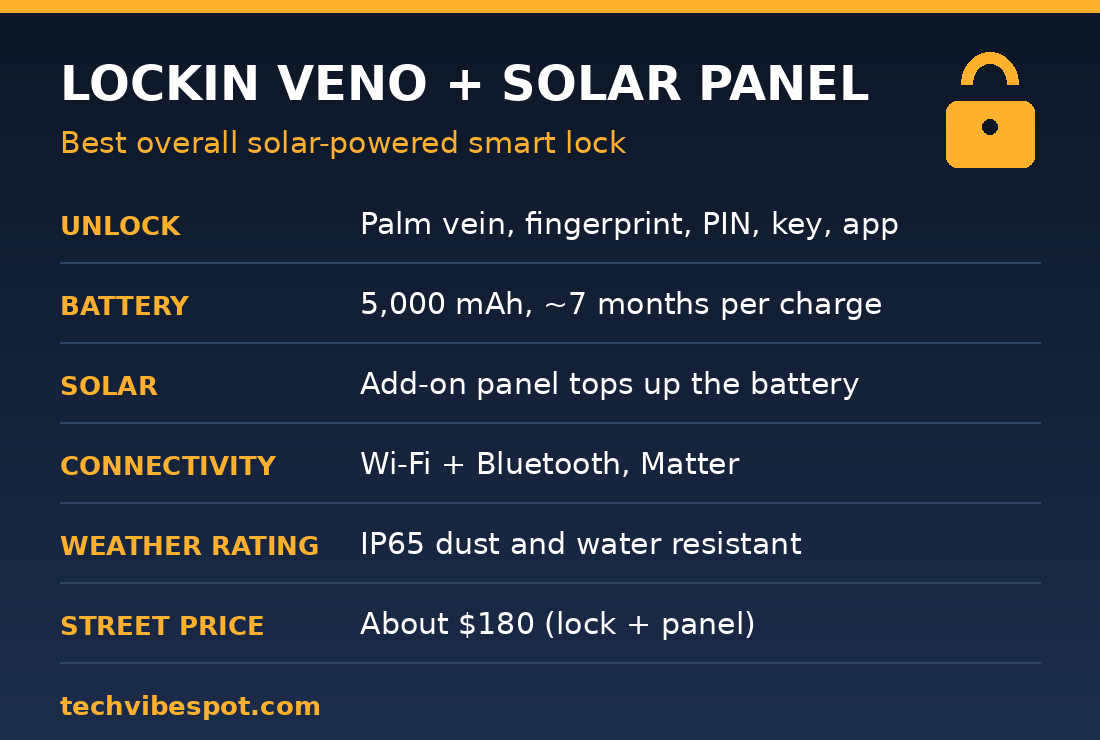
The Lockin Veno with Solar Panel wins this roundup because it does the most with the least fuss. The Veno is a palm-vein deadbolt: hover your hand over the reader and infrared cameras match the vein pattern under your skin. PCWorld’s review called the palm scanner the standout feature and noted the lock streets for $159.99 against a $249 MSRP; the Amazon bundle adds Lockin’s clip-on solar panel and typically lands near $180. Vein patterns don’t fade with age, don’t wear off like fingerprints on dry winter skin, and can’t be lifted off a glass like a print.
Underneath the party trick sits a complete lock. You get a fingerprint reader, a backlit PIN pad, app control over native 2.4GHz Wi-Fi, Matter support for Apple Home, Google Home, and Alexa, and a physical key. The 5,000 mAh battery runs about seven months per charge on its own; the panel exists to make that number academic. Tom’s Guide’s testing of the integrated Veno Solar variant showed the battery trending up week over week, which is the entire pitch of this category in one data point. An IP65 rating means dust-tight and hose-proof, better weather sealing than the IP53 on Lockin’s face-unlock sibling.
It isn’t flawless. PCWorld needed a factory reset to get notifications behaving, and the fingerprint reader sometimes wants a second try, so enroll palms as the primary. The exterior assembly is also large, and the styling reads gadget rather than hardware-store brass.
Buy this if: you want the longest feature list per dollar in a solar lock, palm-vein convenience, and Matter smart-home hooks.
Skip this if: your door sits in permanent deep shade, or you want a lock that looks like a traditional deadbolt.
Check Lockin Veno price on Amazon →
Avia Deadbolt+ with SolarPro: best solar smart lock for Apple Home
The Avia Deadbolt+ with the SolarPro panel is the solar lock to buy if your household runs on iPhones. It is one of the few deadbolts at any price with Apple Home Key, so the door opens with a tap of an iPhone or Apple Watch, even with a dead phone battery via Power Reserve. AppleInsider rated the combination 4 out of 5 and called it “a premium product, with premium features, and a premium price”: $269 for the lock, $43 for the panel, with the Amazon bundle usually undercutting the sum.
The SolarPro is the most interesting retrofit story in this guide. It is a small panel, 2.25 inches wide, that mounts to the front of the lock and feeds rechargeable AA cells in the interior battery compartment. Avia says strong sun covers up to 100 operations a day and stretches battery service to as much as five years. Because it’s an add-on, existing Deadbolt+ owners can bolt on the SolarPro panel later instead of replacing the whole lock.
Know the trade-offs before checkout. The Deadbolt+ speaks Thread and Bluetooth through Apple Home rather than carrying its own Wi-Fi radio, which is great for battery life and useless for Android: there is no Android app, and setup requires an iPhone. The keypad stores just 10 PIN codes. You also get a physical key plus two key fobs, with support for six, one of the widest backup spreads here. It behaves like the no-Wi-Fi smart locks we’ve recommended before: less chatty, longer-lived, fewer remote tricks without a home hub.
Buy this if: everyone on the deed carries an iPhone and you want Home Key with a five-year battery story.
Skip this if: anyone in the house uses Android, or you need more than 10 codes for guests and cleaners.
Check Avia SolarPro bundle price on Amazon →
Lockly Vision Elite: best solar-charging video smart lock
The Lockly Vision Elite is the pick when you want the doorbell camera and the deadbolt to be the same device, and you want solar keeping the whole rig alive. A panel built into the key cover trickle-charges the lithium pack, which Lockly rates for up to five years of use; a micro-USB port stands by as backup. Nothing else in this guide records video: the Elite shoots 1080p with night vision to 15 feet, has two-way audio, and stores about 91 hours of footage on an included 32GB card with no subscription. Gearbrain scored it 7.5/10, praising the build and the anti-peeping keypad.
That keypad is Lockly’s signature PIN Genie, which shuffles digit positions every time so a smudge pattern or a shoulder-surfer learns nothing. There’s also a fingerprint reader that holds 99 prints, app codes, voice control through Alexa and Google, and a physical key. Remote access runs through the included Vision Connect hub over 2.4GHz Wi-Fi, one more box on your shelf, though it spares the lock’s battery from holding a Wi-Fi connection itself.
The price is the pain: around $400 depending on finish and retailer. But stack it against a $250 video doorbell plus a $200 smart lock plus a camera subscription and the single-device math starts working. Reviewers’ main gripes are the hub requirement and a camera angle that loses visitors standing nose-to-door.
Buy this if: you want one hole in the door to handle video, voice, fingerprints, and solar charging with zero monthly fees.
Skip this if: you already own a video doorbell you like, or $400 buys too much lock for your door.
Check Lockly Vision Elite price on Amazon →
DESLOC V150 Plus: best built-in solar panel on a smart lock
The DESLOC V150 Plus is the purest expression of the solar smart lock idea: no add-on panels, no AA cells, just a 4.8-inch perovskite strip on the exterior face feeding a removable 10,000 mAh pack. Perovskite matters because it keeps generating in light as weak as 300 lux, roughly bright indoor lighting, where conventional silicon gives up. CNX Software’s teardown of the spec sheet notes the panel out-produces silicon in cloudy and rainy conditions, which makes this the one solar lock genuinely suited to a covered porch.
The rest of the hardware is aggressive for the money. Unlocking runs through 3D face recognition (dual cameras plus a 24GHz radar that wakes the lock as you approach, 0.7-second matching, sub-0.001% false-accept rate), a curved fingerprint reader DESLOC quotes at 0.15 seconds, a keypad, app control over Wi-Fi and Bluetooth, a physical key, and a USB-C emergency port. It’s rated IP65 and operates from -30°C to 70°C, the widest temperature spread in this roundup. DESLOC claims up to eight months of running with no solar input at all.
The caveats are real. Tom’s Guide found unlocking “relatively slow” in daily use and dinged the missing Matter support, concluding the lock “needs a bit of refinement.” It also started as a Kickstarter, with tiers from about $169 and retail availability rolling out this month, August 2026. Our full DESLOC V150 Plus review digs into the campaign details and the app.
Buy this if: your door gets weak or indirect light and you want face unlock without an Apple ecosystem.
Skip this if: you need Matter/HomeKit today or won’t buy a first-generation crowdfunded lock.
Check DESLOC V150 Plus price →
TEEHO TE001: the under-$100 alternative that skips solar
The TEEHO TE001 is here for the reader doing quiet math: if a $70 keypad deadbolt runs about a year on four AA batteries, the solar premium buys convenience, not necessity. The TE001 has been Amazon’s best-selling keypad deadbolt for years for exactly that reason. You get a backlit keypad, 20 user codes, one-touch locking, auto-lock on a timer, and a five-minute screwdriver install. No app, no radios, no subscription, and nothing to charge; when the AAs fade months from now, the keypad warns you long before it dies.
Understand what you give up. There is no physical key backup, so a fully dead battery means the low-battery warnings were ignored for weeks. There’s no remote access, so you can’t buzz in a guest from your phone; you share a code instead. And it’s keypad-or-nothing: no fingerprints, no palm veins, no faces. For a rental back door, a garage entry, or a first smart lock, none of that tends to matter.
We’ve compared it against its closest rival in TEEHO TE001 vs Wyze Lock Bolt if fingerprint unlocking tempts you at the same price.
Buy this if: you want keyless entry for around $70 and a yearly battery swap doesn’t offend you.
Skip this if: you want any smart-home integration, or a physical key safety net.
Check TEEHO TE001 price on Amazon →
Built-in solar panel or add-on panel: which should you buy?
Buy built-in solar (DESLOC V150 Plus, Lockly Vision Elite) when you’re choosing a new lock from scratch, and an add-on panel (Avia SolarPro, Lockin’s bundle panel) when you’re extending hardware you already like. A built-in panel is engineered into the lock’s weather sealing and power management from day one; DESLOC’s battery management system dynamically routes panel output, and Lockly hides its cells in the key cover so the lock looks like a lock.
Add-on panels win on flexibility and failure isolation. Avia’s SolarPro costs $43, installs during or after lock installation, and if the panel ever fails you’ve lost a $43 accessory, not a $269 deadbolt. The same logic applies to Lockin’s bundle: the Veno works fine without its panel, seven months at a stretch, so the panel is pure upside.
The deciding factor is your door’s light. Built-in perovskite handles shade; add-on silicon panels want real sun. Measure honestly: if the lock face never sees direct daylight, the DESLOC approach is the only solar that will pull meaningful charge, and even then a yearly USB-C top-up is a fair expectation.
Do solar smart locks work in winter and extreme cold?
Solar smart locks keep working in winter, but the solar part contributes less exactly when the battery works hardest. Three things stack against you from November to February: days shorten, snow can physically cover the panel, and rechargeable lithium cells lose capacity and charge reluctantly below freezing. Lockin’s own winter guidance is blunt about it, advising owners to brush snow off the lock face and keep a USB-C power bank accessible before cold snaps rather than assuming the panel will carry the season.
Cold ratings differ more than spec sheets suggest. The DESLOC V150 Plus is rated to -30°C (-22°F), which covers almost any inhabited US ZIP code. Avia’s AA-based design has a quiet winter advantage: you can drop in lithium primary AAs, which shrug off cold far better than alkalines, and let the panel resume duty in spring. Whatever you buy, walk into winter at a full charge. A lock that enters December at 90% will coast to March even if the panel contributes nothing; a lock at 30% might not. Enable low-battery alerts in the app the day you install, and treat the first one as a this-week errand, not a someday one.
What happens if a solar smart lock’s battery dies?
A dead battery does not lock you out of any solar lock in this guide except the TEEHO, because each of the four keeps at least one dumb fallback. The Lockin Veno and DESLOC V150 Plus both hide a physical keyway and carry USB-C ports, so any phone power bank revives the keypad in seconds. The Avia Deadbolt+ takes a standard key and also opens via key fob. The Lockly Vision Elite pairs its key with a micro-USB jump-start port.
You will almost never need any of it. These locks warn at 20-30% through their apps, then nag harder as the cell drains, and the solar panel makes the whole scenario rarer still. But hardware fails and phones die, so our standing advice from the physical key backup guide applies doubly here: before you mount the lock, test the physical key, then store it somewhere that isn’t inside the house it opens.
Which solar smart lock should you buy?
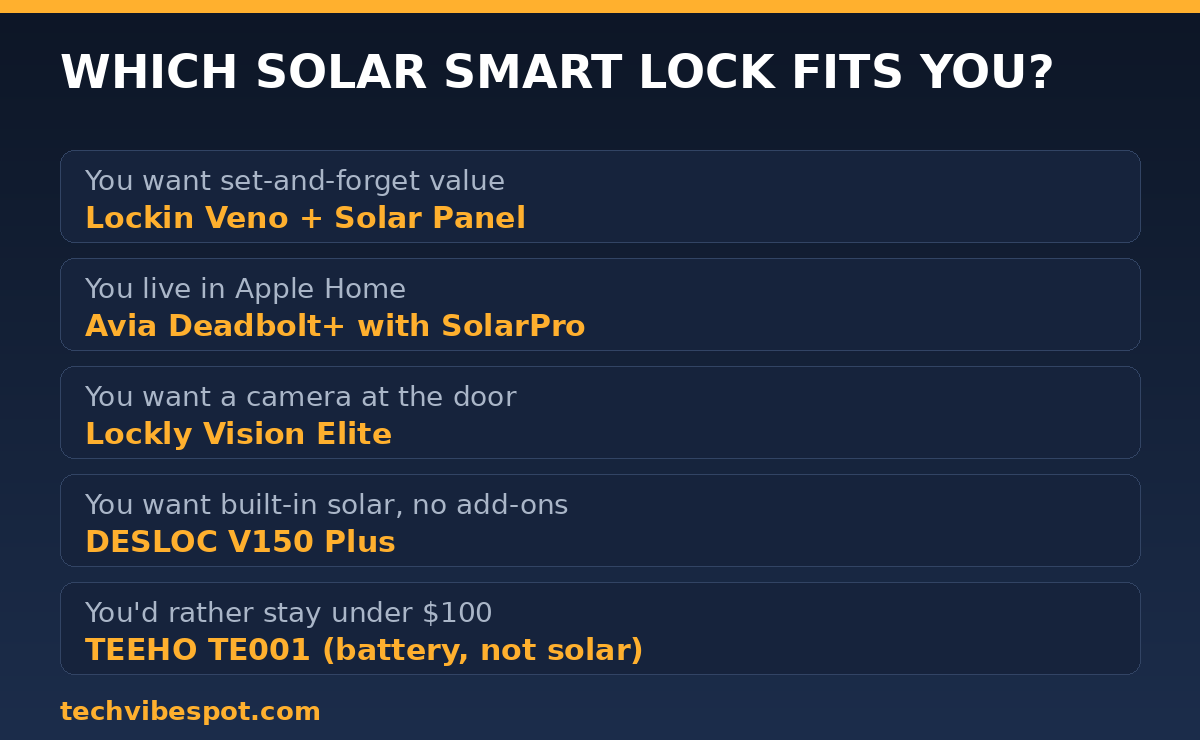
Match the lock to the household, not the spec sheet. If you want the best overall mix of unlocking options, smart-home support, and price, get the Lockin Veno + Solar Panel. If you’re all-in on Apple Home and want Home Key on your wrist, get the Avia Deadbolt+ with SolarPro. If you want video at the door without a subscription, get the Lockly Vision Elite. If your door hides under a porch roof or faces north, get the DESLOC V150 Plus, because perovskite is the only panel chemistry that earns its keep in shade. And if you’ve read this far thinking every one of these is overkill, get the TEEHO TE001, bank the savings, and swap four AAs next summer.
Verdict: the Lockin Veno + Solar Panel is the one to beat
The Veno bundle takes the win because it commits to nothing and delivers everything: palm vein for the gee-whiz, fingerprint and PIN for the family, Matter for whichever smart-home camp you join next, IP65 sealing for the weather, a physical key for the worst day, and a solar panel that quietly turns a seven-month battery into a non-issue. At about $180 it undercuts the Avia bundle by more than $100 and the Lockly by over $200. The runners-up all beat it somewhere: Avia on Apple polish, Lockly on video, DESLOC on shade performance. None of them beats it everywhere.
Check today’s Lockin Veno price on Amazon →
Solar smart lock FAQ
Do solar-powered smart locks need direct sunlight?
Silicon panels like Avia’s SolarPro want a few hours of direct or bright indirect sun daily to hold their charging claims. Perovskite panels, used on the DESLOC V150 Plus, generate power above 300 lux, which includes bright shade and overcast daylight. No panel charges meaningfully at night or under snow.
How long does a solar smart lock last without any sun?
The battery alone carries the lock for months. DESLOC quotes up to 8 months on its 10,000 mAh pack, the Lockin Veno runs about 7 months per charge, and Avia’s rechargeable AAs deliver roughly a year of typical use before the panel is even counted.
Do solar smart locks work in winter?
Yes. The lock operates normally in cold weather; only the charging slows. Shorter days, snow cover, and lithium cells’ dislike of sub-freezing charging all cut solar gains, so enter winter at full charge and keep the USB-C or key backup handy. The DESLOC V150 Plus is rated to -30°C.
What happens if the battery dies completely?
Every solar lock here keeps a fallback: physical keys on all four, USB-C emergency power on the Lockin and DESLOC, micro-USB on the Lockly, and key fobs on the Avia. You’d have to ignore weeks of low-battery alerts to ever need them.
Can I add a solar panel to a smart lock I already own?
Only if it was designed for one. The $43 Avia SolarPro retrofits the Avia Deadbolt+, and Lockin sells its panel for Veno-series locks. There is no universal panel that wires into a Schlage, Yale, or Kwikset deadbolt; for those, rechargeable batteries are the practical upgrade.
Are solar smart locks secure?
The solar panel changes nothing about security; the lock mechanism and electronics do. The picks here use ANSI/BHMA-graded deadbolts, encrypted radios, and biometrics with tiny false-accept rates, like the DESLOC’s sub-0.001% face match. Judge a solar lock by the same standards as any smart lock.
Is a solar smart lock worth it over a regular battery model?
Worth it if the lock gets daylight and you hate maintenance: the panel turns charging from a quarterly chore into a rare event. Not worth it for dark doorways or tight budgets, where a $70 keypad deadbolt like the TEEHO TE001 delivers the same daily convenience for a yearly battery swap.
Sources
Specs and pricing were verified against manufacturer documentation and these independent reviews on August 6, 2026: PCWorld’s Lockin Veno review, Tom’s Guide’s Veno Solar review, AppleInsider’s Avia Deadbolt+ and SolarPro review, CNX Software’s DESLOC V150 Plus breakdown, and Tom’s Guide’s DESLOC V150 Plus review.