
TechVibeSpot earns a commission if you buy through links on this page. That never changes a verdict.
Reolink put the Video Doorbell 2nd Gen on sale July 20, 2026, and three days later the story is already clear: this is the battery video doorbell for people who are done paying monthly fees. At $149.99 (£119.99 in the UK), it undercuts most premium doorbells while promising something none of the big-brand rivals will give you at any price — full-resolution video history stored on a microSD card in the doorbell itself, with no subscription attached to any of it.
The headline change from the first generation is battery life. Reolink switched to Qualcomm’s QCC730 micro-power Wi-Fi chip and now claims up to 10 months per charge, roughly double what the original managed. T3, reviewing the launch on July 21, called battery life the original model’s main weakness and says this generation fixes it. That claim needs independent testing before anyone treats it as gospel, and we’ll flag exactly which numbers are manufacturer math further down.
Our position: if you want a doorbell camera without a recurring bill, this is the launch of the summer. If you live inside the Ring app and your family does too, it is not for you, and no spec sheet changes that.
How we assess: research/news-based analysis, not hands-on testing.
Is the Reolink Video Doorbell 2nd Gen worth buying?
Yes, for most buyers who want zero subscription fees. At $149.99 you get 4MP head-to-toe video, local storage up to 512GB, on-device AI detection, and a claimed 10-month battery. Skip it if you’re committed to the Ring ecosystem or need cloud-first video history without managing a microSD card.
Key takeaways
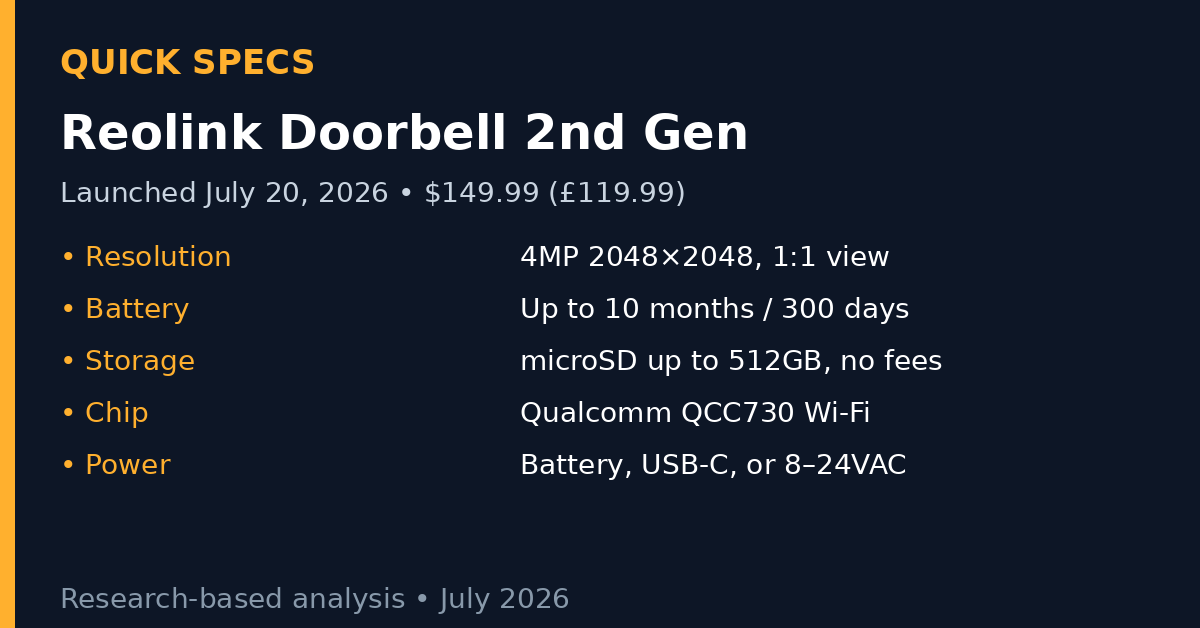
- $149.99 (£119.99) at launch, with discounts running at Reolink.com, cheaper than most premium battery doorbells.
- Up to 10 months (300 days) per charge claimed, based on 5 minutes of recording a day, about 2x the first gen.
- 4MP 2048×2048 square sensor with a 150°-by-150° head-to-toe view and HDR.
- Local storage on microSD up to 512GB, with no monthly fee for recording, playback, or AI detection.
- 2 power paths: battery with USB-C recharge, or 8–24VAC doorbell wiring for constant top-up.
- 2-year warranty plus a 30-day money-back window.

What did Reolink actually launch on July 20, 2026?
Reolink launched a second-generation battery video doorbell built around a low-power Qualcomm Wi-Fi chip, priced at $149.99 (£119.99) and sold through Reolink.com and Reolink’s official Amazon store. Launch discounts are live on Reolink’s own site as of this writing, which makes direct purchase the cheaper route in week one.
The spec sheet reads like a checklist of complaints about the first generation, answered. The camera records 4MP video in a square 2048×2048 frame at 15fps, with HDR and H.264/H.265 encoding off a 1/3″ CMOS sensor. Field of view is 150° horizontal, 150° vertical, 180° diagonal. The point of that unusual geometry is that you see a visitor’s face and the package at their feet in one shot. Detection runs on the device itself: people, vehicles, animals, packages, visitors, and tamper alerts, with smart playback filtering and time-lapse on top. None of it requires a cloud plan.
Connectivity covers dual-band Wi-Fi on 2.4GHz and 5GHz (802.11 a/b/g/n, WPA/WPA2), plus Alexa, Google Assistant and Google Home, and IFTTT. It rings existing mechanical chimes, pairs with the Reolink Chime Plus, and slots into the Reolink Home Hub. Two mics and a speaker handle two-way talk, with quick replies, video calling, and a Voice Mask feature that disguises your voice when you’d rather a stranger at the door not know who’s answering. The housing is IP65-rated, works from -10°C to 55°C, and measures 160.0×48.0×29.5 mm at 231g. Reolink backs it with a 2-year warranty and 30 days to return it.
You can read the full spec sheet on Reolink’s product page. The launch was covered same-week by T3 and picked up by Yahoo Finance, both linked in the sources below.
How does the 4MP head-to-toe view compare to a normal doorbell camera?
The square 1:1 sensor shows more of what actually matters at a front door than a standard widescreen doorbell does. A conventional 16:9 camera frames your porch like a TV show: plenty of horizontal coverage, not much vertical. That’s how you end up with footage of a courier’s torso while the package they set down sits below the frame. The 2nd Gen’s 2048×2048 frame is as tall as it is wide, and with 150° of vertical field of view it captures a visitor from head to toe plus the doormat in front of them.
Resolution-wise, 4MP puts it ahead of the 1080p sensors still common in budget doorbells and in the same working range as premium battery models. The relevant question isn’t megapixels, though. It’s whether the pixels land where you need them. A tall frame spends its resolution on the doorstep zone where packages sit and faces appear. For porch piracy specifically, that’s the right trade.
HDR matters more than it sounds here. Front doors are brutal lighting environments: a bright street behind a visitor standing in a shaded doorway is exactly the scene that blows out cheap sensors. Reolink lists HDR on the spec sheet, and combined with the 1/3″ CMOS it should hold detail in mixed light, though independent image-quality testing hasn’t landed yet and we won’t pretend otherwise.
The 15fps frame rate is the one number that reads modest. Security cameras don’t need cinematic motion, and 15fps is standard practice for battery-powered devices where every frame costs power. You’ll notice it if someone sprints past the door; you won’t notice it when reviewing who rang the bell at 2pm. For a device whose whole pitch is stretching a charge to 10 months, it’s a defensible choice rather than a corner cut.
How long does the battery really last?
Reolink claims up to 10 months (300 days) per charge, and that number comes with an asterisk you should read before repeating it. The figure assumes 5 minutes of recorded footage per day. A quiet suburban door might live inside that budget. A door facing a busy sidewalk, with delivery traffic and a dog that patrols the porch, will burn through far more trigger events and land well short of 10 months. Manufacturer battery claims are best-case arithmetic, and this one is no exception.
What makes the claim more credible than typical spec-sheet optimism is the silicon behind it. The 2nd Gen runs Qualcomm’s QCC730 micro-power Wi-Fi chip, which Reolink says cuts consumption enough to deliver up to 50% longer battery life than standard Wi-Fi cameras. That’s a component-level change, not firmware tuning, and it roughly doubles the first generation’s runtime by Reolink’s own comparison.
The context matters here. T3’s launch coverage on July 21, 2026 was blunt: battery life was the original Reolink doorbell’s main weakness, and this generation fixes it. That’s an assessment of the launch and the spec change, not a completed long-term test; nobody outside Reolink has run this doorbell for 10 months, because it has existed in public for three days.
When the battery does run down, you recharge over USB-C, which means taking the doorbell off the wall for a few hours rather than swapping a pack. That’s the practical argument for the wiring option: connect it to existing 8–24VAC doorbell wires and the battery trickle-charges continuously, turning the whole battery-life question into a non-issue. Our working advice: treat 10 months as the ceiling, plan for less, and if your door already has chime wiring, use it and stop thinking about charge cycles entirely.
Do you need a subscription with the Reolink Video Doorbell 2nd Gen?
No — and that single word is the strongest argument for this doorbell. Recording, playback, smart search filtering, and every AI detection category (people, vehicles, animals, packages, visitors, tamper alerts) run without a cloud plan. Footage saves to a microSD card, up to 512GB, sitting inside the doorbell. You pay once for the hardware and once for a card, and the ongoing cost is zero.
Compare that to how the category leaders operate. Ring and Nest doorbells work without a subscription in a limited sense (live view and alerts), but storing video history in the cloud requires a plan, and those plans typically run several dollars a month, forever. Over a doorbell’s realistic five-year service life, the subscription quietly costs more than the doorbell did. Reolink’s model inverts that: the $149.99 sticker is close to the total cost of ownership.
The AI detail deserves emphasis because it’s where other brands draw the paywall. Package detection in particular is a subscription-gated feature on some competing doorbells. Here it runs on-device, free, alongside the rest of the detection categories. On-device processing also means clips get analyzed without a round trip to a server, which is a privacy point as much as a cost point.
There is an optional Reolink Cloud tier in selected countries for people who want off-site backup, a reasonable want, since a stolen doorbell takes its microSD card with it. That’s the honest weakness of local-only storage, and the Reolink Home Hub (which can store footage inside your house instead) is the ecosystem’s answer to it. But the key word is optional. Nothing about the core experience degrades if you never give Reolink another dollar, and in a market where the business model is increasingly the subscription rather than the hardware, that’s the whole reason this product exists.
Should you hardwire it or run it on battery?
Hardwire it if you have doorbell wires; the feature gap makes this an easy call. On battery, the 2nd Gen records motion-triggered clips only: it wakes when something happens, captures the event, and goes back to sleep to protect the charge. Connect it to 16–24VAC wiring and enable Wired Power Mode, and it becomes a different class of device: 24/7 continuous recording plus pre-recording, meaning the timeline includes what happened before the motion trigger fired, not just after.
That pre-roll gap is the classic battery-doorbell blind spot. A triggered clip often starts with a person already mid-frame, or already walking away with your package. Continuous recording closes that hole completely, and with up to 512GB of microSD on board, there’s room for a serious stretch of around-the-clock footage without cloud fees.
The wiring itself is standard low-voltage doorbell fare: the doorbell accepts 8–24VAC for power and charging, with the 16–24VAC range unlocking Wired Power Mode. If your house has an existing chime, the 2nd Gen works with mechanical chimes, so the familiar ding-dong inside the house survives the upgrade. No transformer in the wall? The battery path is genuinely usable: USB-C recharging and the QCC730 chip’s claimed 10-month endurance make it the best-case version of a battery doorbell. You just live with clip-based recording.
One more option worth knowing about: Reolink also sells a dedicated wired doorbell with chime as a separate product. If you know from day one that you want a permanently powered unit and don’t care about battery flexibility at all, compare against the Reolink wired video doorbell with chime on Amazon before deciding. For everyone else, the 2nd Gen’s dual-mode design is the more flexible buy: start on battery, hardwire later, lose nothing in between.
Who should buy it — and who should skip it?
Buy it if a recurring fee is the thing standing between you and a video doorbell. That’s the clean dividing line. The 2nd Gen was built for people who look at doorbell subscription pricing, multiply by 60 months, and close the tab. It suits homeowners with or without doorbell wiring, self-hosters who already run Reolink cameras or a Home Hub, and anyone who wants package detection without paying a gatekeeping fee for it.
It also fits privacy-minded buyers unusually well. Footage lives on a card in your doorbell (or your Home Hub), not on a company’s servers by default. AI detection happens on the device. The Voice Mask feature disguises your voice when answering strangers. That stack of choices adds up to a doorbell that shares as little as you want it to.
Skip it if you’re deep in the Ring ecosystem. Reolink talks to Alexa, Google Home, and IFTTT, but it doesn’t appear in the Ring app alongside Ring cameras, and households that have standardized on one app rarely enjoy running two. Skip it too if you want cloud video history as the default rather than an option in selected countries, or if the idea of a microSD card as your evidence locker makes you nervous and you don’t want to add a Home Hub to fix that.
And skip it, at least for a few weeks, if you’re the kind of buyer who wants third-party test data before spending $149.99. This product is three days old. The spec sheet is compelling and T3’s early read is positive, but battery claims, HDR performance, and detection accuracy all await independent verification. Early adopters get launch pricing; patient buyers get certainty. Pick your trade.
How does it compare to Ring and Blink doorbells?
Against the two most common alternatives, the Reolink wins on ongoing cost and resolution, Ring wins on ecosystem, and Blink wins on entry price. That’s the comparison in one sentence; here’s the texture.
The Ring Battery Doorbell Plus (with a spare quick-release battery) is the closest philosophical rival: it also shoots a head-to-toe view, at 1536p HD+, and its removable battery means you swap packs instead of taking the doorbell down to charge. Ring’s real advantage is everything around the doorbell: the app, the accessory range, the neighbor network, the sheer install base. Its structural disadvantage is the business model: storing video history in the cloud requires a subscription, typically several dollars a month, and without one you’re limited to live view and alerts. Reolink’s 4MP sensor out-resolves it and the microSD slot out-prices it over any multi-year horizon.
The Blink Video Doorbell with Sync Module is the budget play: the cheapest respectable way to get any video doorbell on your door. It records 1080p in a conventional aspect ratio, and the Sync Module matters more than it looks: with a USB drive plugged into a Sync Module 2, Blink offers local storage without a subscription, which makes it the only big-brand option that shares Reolink’s no-fee philosophy, in a rougher, lower-resolution form. If the budget stops near half the Reolink’s price, Blink is the honest answer.
Reolink’s own Amazon presence is worth a note: the 2nd Gen is rolling out through Reolink’s official Amazon store, so check Reolink’s battery head-to-toe doorbell listing on Amazon and confirm “2nd Gen” on the listing before buying; the first-generation model shares the family name and the 1:1 head-to-toe framing.
| Reolink Video Doorbell 2nd Gen | Ring Battery Doorbell Plus | Blink Video Doorbell | |
|---|---|---|---|
| Price positioning | $149.99 (£119.99) at launch | Mid-range; check current listing | Cheapest of the three |
| Resolution / view | 4MP 2048×2048, 1:1 head-to-toe, HDR | 1536p HD+, head-to-toe view | 1080p, standard view |
| Battery | Up to 10 months claimed (5 min/day); USB-C recharge | Removable quick-release pack; spares available | Runs on AA lithium batteries |
| Local storage | microSD up to 512GB in the doorbell | None; cloud-based history | Via USB drive on Sync Module 2 |
| Subscription needed? | No; optional cloud in selected countries | Yes, for cloud video history | No, if using Sync Module local storage |
| Smart home | Alexa, Google Home, IFTTT | Alexa (Ring ecosystem) | Alexa (Blink/Amazon ecosystem) |
Which buyer are you? Four situations, four answers
If you’re a renter, run the 2nd Gen on battery. No wiring, no landlord conversation, no holes beyond the mounting bracket, and the claimed 10-month charge cycle means the take-down-and-recharge ritual happens once or twice a year at most. When you move, the doorbell and its microSD card full of footage move with you. The 30-day money-back window covers you if your building’s door situation turns out not to suit it.
If you’re an Airbnb host, hardwire it and turn on Wired Power Mode. Continuous 24/7 recording with pre-recording gives you a complete exterior record of arrivals and departures (genuinely useful for guest disputes) without a per-property subscription multiplying across your listings. Doorbell cameras pointed at an exterior entrance sit on the right side of most platform camera policies, but disclose it in your listing and check the current rules for your platform and jurisdiction.
If you’re a Ring ecosystem owner, stay put. Adding a Reolink doorbell to a Ring household means two apps, two alert streams, and none of your existing chimes or automations carrying over. The Ring Battery Doorbell Plus keeps everything in one app, and its head-to-toe view answers the framing argument. You’ll keep paying for cloud history, but ecosystem coherence is worth real money in daily use.
If you’re a budget buyer, the Blink Video Doorbell with a Sync Module is the cheapest way through the door, and pairing it with a USB drive on a Sync Module 2 even gets you subscription-free local storage. You give up resolution, the tall frame, and the richer detection categories. If you can stretch to $149.99, the Reolink buys a lot of camera for the gap; if you can’t, Blink is a perfectly rational floor.
Confirmed vs still unverified: what we actually know three days in
Confirmed by primary sources. The launch date (July 20, 2026), pricing ($149.99 / £119.99), and availability through Reolink.com and Reolink’s official Amazon store come from Reolink’s own announcement and product page. So do the hardware specs: 4MP 2048×2048 sensor, 150°/150°/180° field of view, the Qualcomm QCC730 chip, dual-band Wi-Fi, microSD support to 512GB, IP65 rating, -10°C to 55°C operating range, 231g weight, and the 2-year warranty. T3’s independent launch coverage confirms the positioning: this generation exists to fix the original’s battery problem.
Manufacturer claims, not yet independently tested. The 10-month battery figure is Reolink’s number, calculated from 5 minutes of recording per day; real doors with real foot traffic will vary, possibly by a lot. The “up to 50% longer battery life than standard Wi-Fi cameras” comparison is likewise Reolink’s framing of the QCC730’s benefit. Treat both as directionally credible and numerically unproven.
What independent testing hasn’t confirmed yet. Real-world image quality: HDR performance in harsh backlight, night detail, motion clarity at 15fps. AI detection accuracy across the six categories, especially false-positive rates on busy streets. Actual battery drain under continuous 24/7 recording in Wired Power Mode versus battery-mode clips. Long-term weather resilience beyond the IP65 paper rating. App reliability at scale. None of this is a strike against the product; it’s what “released three days ago” means. We’ll update this review as third-party test data lands, and the confirmed column above is already strong enough to justify the early verdict for no-subscription buyers.
FAQ: Reolink Video Doorbell 2nd Gen
When was the Reolink Video Doorbell 2nd Gen released?
Reolink announced and put the Video Doorbell 2nd Gen on sale on July 20, 2026. It’s available from Reolink.com, where launch discounts are active, and it is rolling out through Reolink’s official Amazon store. Coverage from T3 and Yahoo Finance followed within a day of the announcement.
How much does the Reolink Video Doorbell 2nd Gen cost?
The list price is $149.99 in the US and £119.99 in the UK. Reolink.com is running launch discounts as of late July 2026, so the effective price may be lower in the early weeks. There are no mandatory ongoing costs: recording, playback, and AI detection all work without a subscription.
Does the Reolink Video Doorbell 2nd Gen need a subscription?
No. Footage records to a microSD card (up to 512GB) inside the doorbell, and all AI detection (people, vehicles, animals, packages, visitors, and tamper alerts) runs on the device without a cloud plan. An optional Reolink Cloud service exists in selected countries for off-site backup, but nothing in the core experience requires it.
How long does the battery last on one charge?
Reolink claims up to 10 months (300 days) per charge, based on 5 minutes of recording per day, enabled by the Qualcomm QCC730 micro-power Wi-Fi chip. That’s roughly double the first generation. Busier doors will see shorter runtimes, and independent long-term testing hasn’t confirmed the figure yet. Recharging is via USB-C.
Does it work with Alexa and Google Home?
Yes. The Reolink Video Doorbell 2nd Gen works with Amazon Alexa, Google Assistant and Google Home, and IFTTT. It also connects over dual-band Wi-Fi (2.4GHz and 5GHz), rings existing mechanical chimes, and pairs with the Reolink Chime Plus and the Reolink Home Hub for whole-home integration.
Can the Reolink Video Doorbell 2nd Gen record 24/7?
Only when hardwired. Connected to 16–24VAC doorbell wiring with Wired Power Mode enabled, it records continuously around the clock and adds pre-recording, capturing moments before a motion trigger. On battery power, it records motion-triggered clips only, which is how it protects the claimed 10-month charge cycle.
Is the Reolink Video Doorbell 2nd Gen weatherproof?
It carries an IP65 rating, which covers dust and water jets; normal rain and porch conditions are within spec. The rated operating range is -10°C to 55°C (14°F to 131°F). Reolink backs the hardware with a 2-year warranty and a 30-day money-back period, which covers early hardware issues in harsh installs.
Sources
- Reolink launch press release (PR Newswire) — Verified July 23, 2026
- Reolink Video Doorbell 2nd Gen official product page — Verified July 23, 2026
- T3: Reolink’s new video doorbell fixes the last one’s biggest issue — Verified July 23, 2026
- Yahoo Finance: Reolink releases Video Doorbell 2nd Gen — Verified July 23, 2026