TechVibeSpot earns a commission if you buy through links on this page. That never changes a verdict.
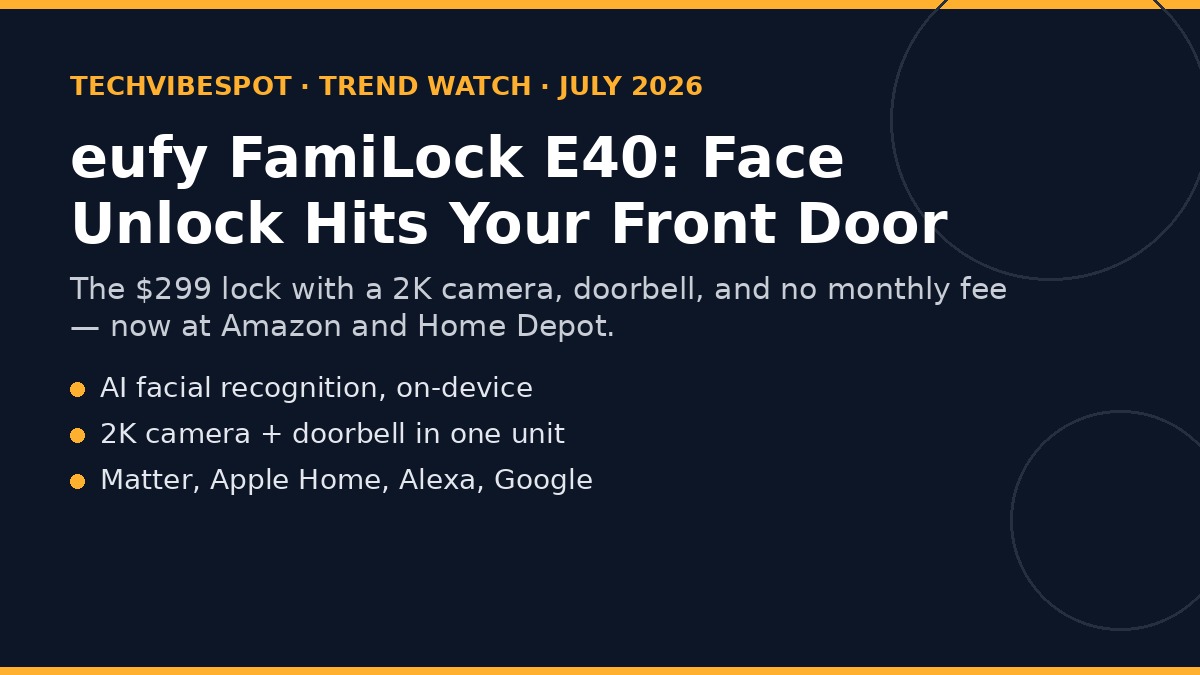
Face unlock finally made it to the American front door at a price normal people will pay. The eufy FamiLock E40 went on sale at Home Depot in June, and this month the rollout widened to Amazon and eufy.com, putting a $299.99 lock with AI facial recognition, a 2K camera, and a built-in doorbell one click away for most US buyers. Deal trackers lit up within days. The palm-vein E34 dipped to $179.99 on Slickdeals this month, the S3 Max touched $280, and the E40 itself is holding at list while stock spreads. That flurry is exactly why this lock is the one to evaluate right now.
How we assess: research/news-based analysis, not hands-on testing.
Is the eufy FamiLock E40 worth $299.99? For most US households that want face unlock without a subscription, yes. You get on-device facial recognition for up to 50 faces, a 2K camera with doorbell, IP65 weather sealing, and Matter support with no monthly fee. Skip it if your state restricts biometric entry or you only need a keypad.
Key takeaways
- 1. The FamiLock E40 costs $299.99 (about £236 / AU$455 at current conversion; US pricing is official) and is now sold at Amazon, eufy.com, and Home Depot.
- 2. It stores up to 50 faces and 50 fingerprints, and every biometric match is processed on the lock itself, not in the cloud.
- 3. The 2K camera covers a 135-degree head-to-toe view and doubles as a video doorbell, so one hole in your door does three jobs.
- 4. There is no required subscription. Recordings stay local, which is increasingly rare in video locks.
- 5. Radar-based motion sensing cuts false alerts compared with the PIR sensors most video doorbells still use.
- 6. It works with Apple Home, Google Home, Alexa, SmartThings, and Matter, though camera feeds inside each ecosystem have limits we flag below.
- 7. A no-camera budget route exists: the TEEHO TE001 keypad deadbolt runs about $36 and covers plain code-based entry.
What is the eufy FamiLock E40, and why is it suddenly everywhere?
The FamiLock E40 is eufy’s new flagship smart deadbolt, announced on June 10, 2026 as part of an expanded FamiLock lineup and positioned as the mainstream face-unlock option in the range. It combines three devices in one housing: a motorized deadbolt, a 2K security camera, and a doorbell. Anker’s eufy brand launched it first through roughly 30 Home Depot stores, then opened online ordering through eufy.com and Amazon in July, which is why coverage and deal threads spiked this month rather than at announcement. The launch lineup brackets it neatly. The E32 is the $139.99 entry model, the E35 at $299.99 swaps face unlock for palm-vein reading, and the E40 carries the camera and facial recognition. eufy says the E40’s recognition runs entirely on the device, storing up to 50 enrolled faces, and pairs it with radar motion detection to spot a person before they reach the door. The company’s pitch is a two-second walk-up-and-unlock flow: the lock sees an enrolled face, verifies it locally, and drives the bolt before you touch the handle. Weather sealing is rated IP65, enough for direct exposure on an uncovered door, and the whole thing carries no mandatory subscription. Storage is local, alerts are free, and the camera keeps working without a monthly bill, which separates it from most video-doorbell ecosystems that meter cloud clips.
How much does the FamiLock E40 cost, and where can you actually buy it?
List price is $299.99 in the US. UK and Australian storefronts had not posted official local pricing at the time of writing, so treat any £ or AU$ figure you see as a conversion estimate rather than a promise (roughly £236 / AU$455 before local taxes). At $299.99 it lands in a crowded bracket: the palm-vein FamiLock S3 Max floats between $279.99 and $299.99 depending on the week, Chamberlain’s myQ Secure View 3-in-1 plays in the same video-lock category, and Lockly and Aqara both sell capable biometric locks in the $200 to $330 band. Availability is the real story this month. Home Depot stocks the E40 in stores and online, and the Amazon listing is live with Prime shipping. If you want it, there is no waitlist. Deal watchers should note the pattern across the FamiLock family: eufy discounts aggressively and often. The S3 Max hit $280 at Amazon on July 2, and the step-down E34 palm-vein lock has cycled between $179.99 and $196.99 in Slickdeals threads over the past three weeks. The E40 is new enough that it has mostly held list price, but if eufy follows its own playbook, the first meaningful cut should arrive within a quarter. Buying now costs you the launch premium; waiting costs you the summer install window. Pick your poison.
Check the eufy FamiLock E40 price at Amazon
How does face unlock on the E40 actually work?
The E40 uses an AI vision model running on the lock’s own silicon. You enroll a face through the eufy app, the lock builds a template, and from then on the camera watches its 135-degree field for approaching people. eufy pairs the camera with radar sensing, which measures motion physically rather than by pixel change, so shadows, headlights, and swaying branches are less likely to wake the system. When the radar flags a person and the camera matches an enrolled face, the deadbolt retracts. eufy quotes up to 50 stored faces, which is family-plus-relatives territory, and the same capacity applies to fingerprints on the reader below the camera. Two design choices matter more than the spec sheet numbers. First, matching happens on-device. The face template never leaves the lock for verification, which shortens unlock time and shrinks the privacy attack surface compared with cloud-matched systems. Second, face unlock is one of five entry methods, not the only one. Fingerprint, PIN pad, app control, and a physical key all remain, so a rainy night with a hood up or a camera fault never locks you out. What we could not verify from available reporting: false-accept and false-reject rates, twin handling, and performance in strong backlight. No named third-party lab had published E40 recognition-accuracy testing at the time of writing, and eufy does not quote error rates. Treat recognition reliability as promising but unproven until independent tests land. One legal note before you order: video locks with biometric entry face restrictions in some jurisdictions. Chamberlain disables face and fingerprint features on its rival lock in Illinois and Texas, and Illinois’ BIPA law is the reason biometric products often carve out that state. Check your state’s rules if you live in one of those markets.
Is the E40 better than the eufy FamiLock S3 Max?
They cost about the same, so this is the comparison most buyers actually face. The S3 Max reads palm veins: you hover a hand and infrared optics match the vein pattern beneath the skin. It also packs a 2K HDR doorbell camera, 16GB of local storage, a rear-facing video screen so you can see who is outside from the inside handle, and an ANSI/BHMA Grade 1 rating, the highest residential deadbolt grade. The E40 counters with true face unlock, meaning nothing to present and no gesture to make, plus the newer radar detection stack. Choose by failure mode, not by headline feature. Face recognition works hands-free but must cope with light, hats, sunglasses, and aging templates. Palm veins do not care about lighting or facial changes, and they are extremely hard to spoof, but you must raise a hand each time. Households with kids whose faces change fast, or anyone uneasy about a camera template of their face, should lean S3 Max. People carrying groceries every day, or anyone who wants the door open before they reach it, should lean E40. If maximum physical security certification matters, note the S3 Max’s published Grade 1 rating; eufy had not published an equivalent BHMA grade for the E40 at the time of writing, which is a genuine gap in the spec sheet, not a deficiency we can score either way.
See the eufy FamiLock S3 Max at Amazon
How does the E40 compare with the rest of the 2026 field?
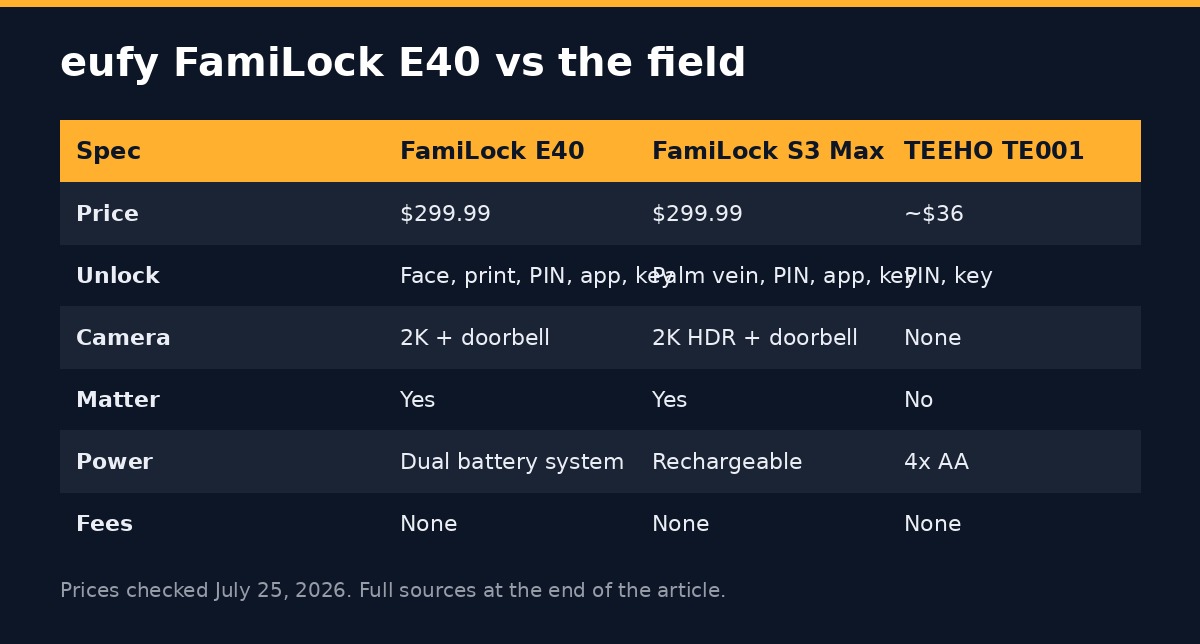
Here is the wider bracket, using list prices and manufacturer specs verified this week.
| Lock | Price (US list) | Biometric | Camera | Subscription | Matter |
|---|---|---|---|---|---|
| eufy FamiLock E40 | $299.99 | Face + fingerprint | 2K, 135° + doorbell | None | Yes |
| eufy FamiLock S3 Max | $299.99 (often $280) | Palm vein + fingerprint | 2K HDR + doorbell, rear screen | None | Yes |
| Chamberlain myQ Secure View | Unpublished; sold via myQ.com | Face + fingerprint | 2K HDR doorbell | Optional cloud tiers | No (myQ ecosystem) |
| TEEHO TE001 | ~$36 | None (keypad) | None | None | No |
The pattern is clear. eufy is bundling hardware that rivals sell piecemeal — lock, doorbell, camera — and skipping the subscription that usually follows. Chamberlain’s myQ Secure View matches the 3-in-1 concept with a five-method entry list and two-second unlock, but it launched in January with regional biometric carve-outs and lives inside the myQ app world rather than Matter. Aqara’s U400, the UWB standout we covered separately, remains the pick for Apple-first homes that want hands-free unlocking driven by your phone’s radio rather than your face. And the TE001 exists to remind everyone that keyless entry itself costs $36; everything above that price buys convenience, video, and integration, not the basic ability to stop carrying keys.
What are the E40’s weak spots?
Every launch has soft points, and reporting plus early listings surface five here. First, ecosystem video support is uneven. Matter standardizes lock control, not camera streams, so how much of the E40’s video you see inside Apple Home or Google Home depends on eufy’s per-platform integrations, and early documentation does not promise native HomeKit Secure Video. If in-app camera feeds inside your chosen ecosystem are the whole point for you, verify that specific integration before buying. Second, no independent accuracy data exists yet for the face engine, as noted above. Third, the published spec sheet omits a BHMA security grade, while the cheaper-when-discounted S3 Max advertises Grade 1. Fourth, biometric-entry restrictions in a handful of US states are the industry’s problem rather than eufy’s, but they are still your problem if you live there. Fifth, eufy’s brand history includes a 2022-era controversy about camera streams that were more accessible than the company claimed; eufy re-architected and now leans hard on local processing, but buyers with long memories will want to weigh that record. None of these is disqualifying. Together they explain why our verdict is positive with conditions rather than a blanket endorsement.
How hard is the FamiLock E40 to install?
Installation follows the standard retrofit-deadbolt pattern, and that is good news. The E40 replaces an existing deadbolt in a US standard bore hole, so the job is a screwdriver, two plates, and a cable pass-through rather than a locksmith visit. eufy’s FamiLock installs are consistently reported in the 20-to-45-minute range for first-timers across the lineup, and nothing in the E40’s design changes that: the exterior assembly carries the camera and reader, the interior assembly carries the batteries and motor, and a connector joins them through the door. Three practical checks before you order will save a return. Measure your door thickness, since very thin storm-style doors and very thick custom slabs fall outside standard fitment. Confirm your door has a true deadbolt bore separate from the handle, because the E40 is a deadbolt replacement, not a handle set. And check your Wi-Fi signal at the door itself; a lock that drops connection at the edge of your router’s range will still unlock by face, print, PIN, and key, but remote features get flaky. Power is a dual-battery system, which in eufy’s design means you can hot-swap without the lock ever going dark, and a physical key remains the dead-simple mechanical fallback if you somehow run everything flat. Renters and DIY-shy buyers should also note what the E40 does not require: no drilling of new holes, no wiring to doorbell transformers, and no hub purchase for core functions, though Matter setups work best with a Thread-capable hub already in the house.
What’s confirmed about the E40 — and what still isn’t?
Launch coverage blurs press-release claims into facts, so here is the honest ledger. Confirmed by eufy’s announcement and retail listings: the $299.99 price, face and fingerprint capacity of 50 each, 2K resolution with a 135-degree head-to-toe field, built-in doorbell function, radar person detection, IP65 rating, on-device processing, no-subscription local storage, and compatibility spanning Apple Home, Google Home, Alexa, SmartThings, and Matter. Also confirmed: availability at Home Depot plus the July online expansion to Amazon and eufy.com, and the surrounding lineup of the $139.99 E32 and palm-vein E35. Manufacturer-claimed but not yet independently measured: real-world recognition speed in the advertised two-second band, battery life between charges under normal traffic, and recognition accuracy across lighting, weather, and edge cases like similar-looking siblings. Unpublished as of this writing: any ANSI/BHMA security grade for the E40, official UK or Australian pricing, and HomeKit Secure Video support. Nothing in the unverified column is a red flag; all of it is the normal fog of a product that shipped weeks ago and has not yet been through the lab-review cycle at major testing outlets. But if your buying decision hinges on an item in the second or third list, the rational move is to wait one quarter for independent numbers rather than assume the spec sheet resolves in your favor.
Who should buy the eufy FamiLock E40 — and who shouldn’t?
If you’re a family with school-age kids who lose keys and forget codes, the E40 is the strongest fit on the market right now: faces are the one credential children cannot leave at practice. If you’re a frequent online shopper who wants one device answering the door and recording it, the built-in doorbell camera removes a separate purchase and a separate battery to charge. If you’re subscription-averse, the E40 and the wider FamiLock family are the clearest no-monthly-fee path to a video lock. If you run a short-term rental, look elsewhere; guests will not enroll faces for a weekend stay, and our Airbnb lock guide covers better code-first options. If you’re an Apple Home purist who wants everything native including video, wait until HomeKit-specific integration details firm up, or pick a lock built around Home Key. If your door already has a good camera doorbell beside it, the cheaper E35 or a discounted S3 Max delivers the same keyless core without paying twice for glass you already own. And if $300 was never the budget, a $36 keypad deadbolt genuinely covers the basics.
Check the TEEHO TE001 budget keypad deadbolt at Amazon
Verdict: the first face-unlock lock that feels mainstream
The FamiLock E40 is not the most secure lock you can buy on paper — the S3 Max’s palm vein and Grade 1 rating take that crown inside eufy’s own lineup. It is the most frictionless one. Face unlock with local processing, a real 2K doorbell camera, radar detection, and zero subscription at $299.99 undercuts the effort and running cost of stitching those pieces together separately. The launch-window caveats are real: unproven accuracy in the wild, thin third-party testing, and ecosystem video questions. But the direction is unmistakable. Video locks spent two years drifting toward $400 hardware plus $5-a-month clouds, and eufy just shipped the counterargument into every Home Depot. If the E40’s face engine proves out in independent testing this fall, this becomes the default recommendation at $300. Right now it is the smart early adopter’s pick, and a fair one.
A note on timing your purchase. eufy runs promotions on a fast cycle, and the FamiLock family has already shown its cadence: launch at list, first bundle deals within a month, then rotating 10-to-20-percent cuts through the big retail moments. Between now and the holidays sit at least three of those moments — back-to-school in August, October’s fall Prime event, and Black Friday. If the E40 follows the S3 Max’s curve, a $260-to-$270 street price by November is a reasonable expectation, not a fantasy. Against that, summer is when locks get installed: daylight, warm weather, and, if you have students heading off or family cycling through, an immediate payoff from code- and face-based entry. There is no wrong answer, but there is a wrong reason — do not pay list price in July expecting the price to hold. Buy now because you want the summer install, or set a price alert and buy the first dip.
FAQ
Does the eufy FamiLock E40 require a subscription?
No. Recording, alerts, and all unlock methods work without any monthly fee, and footage is processed and stored locally rather than in a mandatory cloud plan.
How many faces and fingerprints can the E40 store?
Up to 50 faces and 50 fingerprints. That covers large households plus regular visitors like relatives, sitters, and dog walkers, and entries can be added or revoked from the eufy app.
Does the FamiLock E40 work with Apple Home, Alexa, and Google Home?
Yes, lock control works across Apple Home, Google Home, Alexa, SmartThings, and Matter. Camera-feed depth varies by platform, so check the specific video integration you care about before buying.
What happens if face unlock fails or the camera gets dirty?
Four fallbacks remain: the fingerprint reader, the PIN keypad, the eufy app, and a physical key. A recognition failure inconveniences you; it cannot lock you out.
Is the E40 weatherproof enough for an exposed door?
It carries an IP65 rating, which protects against dust and water jets from any direction. That is adequate for uncovered doors in rain and snow, though shade extends camera life in extreme heat.
Where is the eufy FamiLock E40 available in July 2026?
Amazon, eufy.com, and Home Depot in the US, both online and in select stores. UK and Australia had no official launch pricing at the time of writing.
Is the E40 or the S3 Max more secure?
On published specs, the S3 Max: palm-vein patterns are harder to spoof than faces, and it advertises an ANSI/BHMA Grade 1 rating the E40’s sheet currently lacks. The E40 is the more convenient of the two.
Can renters install the FamiLock E40?
Mechanically yes — it replaces a standard deadbolt with a screwdriver and keeps the door re-keyable. But biometric hardware on a rental door usually needs landlord sign-off, so ask first.
Sources
- eufy Security press release: expanded FamiLock lineup (Verified July 25, 2026)
- AndroidGuys: FamiLock E40 launch details (Verified July 25, 2026)
- Quvii: FamiLock E40 specifications (Verified July 25, 2026)
- PR Newswire: Chamberlain myQ Secure View launch (Verified July 25, 2026)
- 9to5Toys: FamiLock S3 Max $280 deal (Verified July 25, 2026)
- Home Depot: FamiLock E40 listing (Verified July 25, 2026)