TechVibeSpot earns a commission if you buy through links on this page. That never changes a verdict.
If you bought a cheap fingerprint deadbolt on Amazon in the last two years, there is a decent chance it runs on a platform called TTLock. It is the invisible software behind a huge slice of the sub-$120 smart lock market. And this week, thanks to a scheduled talk at DEF CON 34 and a stack of older unpatched flaws, a lot of owners are suddenly asking the same question: is the lock on my front door actually secure?
This is a research-based breakdown of what is confirmed, what is still rumor until the talk happens, and what a security-minded buyer should do about it. No fear-mongering, no “throw it in the trash tonight” theatrics. Just the facts and a few better places to put your money.
How we assess: research/news-based analysis, not hands-on testing.
Are TTLock smart locks safe in 2026? For most homes they are “good enough” against a casual intruder, but the TTLock/Sceiner platform carries a set of publicly disclosed, still-unpatched Bluetooth vulnerabilities from 2024, and fresh research on its “time management” access system is being presented at DEF CON 34 on August 7-9, 2026. A determined attacker within Bluetooth range of the door is the realistic threat, not someone across town. If your lock guards a rental, a small business, or a high-traffic entry, moving to a mainstream brand with an active security team is the safer call.
Key takeaways
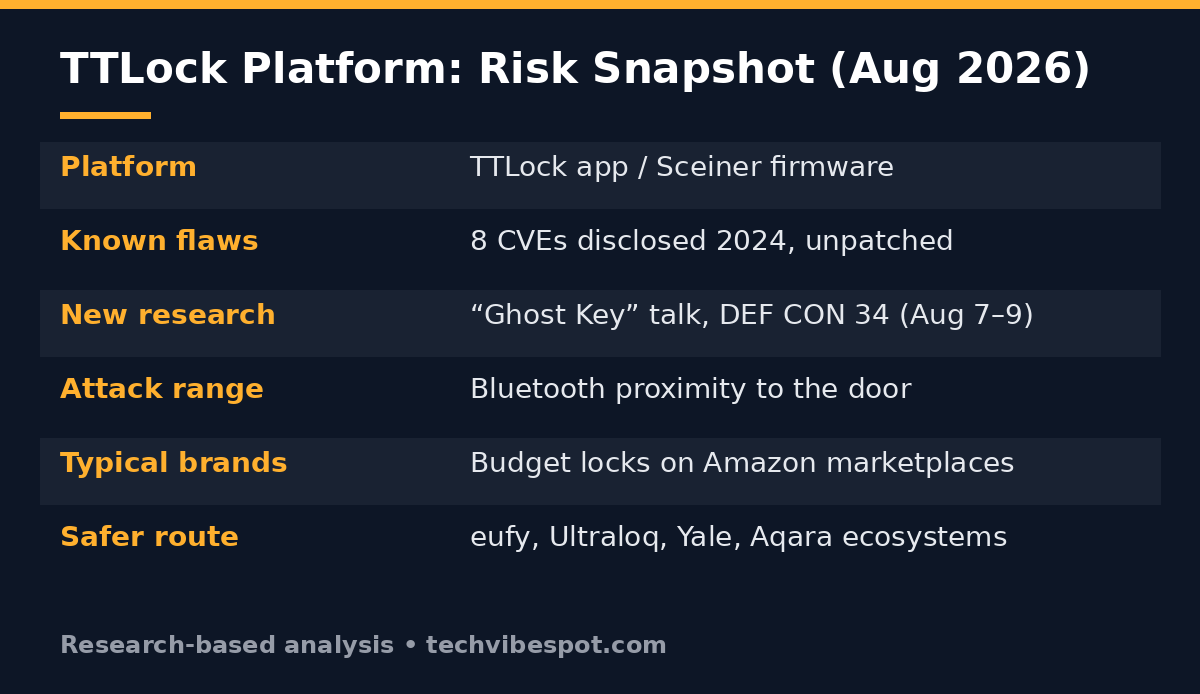
- 8 CVEs were disclosed against the Sceiner firmware and TTLock app in 2024, and as of this writing no vendor patch has shipped.
- Under 40 minutes is how long researchers said a brute-force attack could take on affected locks, from within Bluetooth range.
- August 7-9, 2026 is DEF CON 34, where a talk titled “The Ghost Key” targets TTLock’s time-limited access codes directly.
- ~$95 gets you into a mainstream alternative with an active security team (eufy C220), our budget pick below.
- Zero confirmed reports of mass remote hacking — the realistic risk is a local attacker at your door, not the internet at large.
What is TTLock, and why is it suddenly in the news?
TTLock is not a lock brand you will see stamped on a box. It is a white-label platform — app, cloud, and firmware — that dozens of manufacturers license and ship inside their own hardware. Search “TTLock smart lock” on Amazon and you get a wall of near-identical keypad deadbolts from names most shoppers have never heard of. They are cheap, they work, and they all phone home to the same ecosystem, which is built by a company called Sceiner.
That shared plumbing is exactly why the platform matters. When a flaw exists in the TTLock app or the underlying Sceiner firmware, it does not affect one product. It potentially affects every lock built on top of it. The news hook this week is a DEF CON 34 presentation, “The Ghost Key: Illusions of ‘Time Management’ in TTLock Smart Locks,” from researchers Yang Liu and Zhenghan Wang, scheduled during the conference’s August 7-9, 2026 run in Las Vegas. The title points squarely at the temporary-access feature that Airbnb hosts and small landlords rely on.
Here is the honest caveat: the full technical details of that specific talk are not public until it is delivered. So we are separating what is already documented from what is still to come.
Which smart locks actually use TTLock?
This is the part that trips people up. There is no giant “TTLock Inc.” lock. Instead, look at the app your lock told you to download during setup. If it was the TTLock app (or a lightly rebranded clone of it), your hardware sits on this platform. The affected population skews heavily toward budget keypad deadbolts and padlocks sold through online marketplaces, often under rotating brand names.
Mainstream locks generally run their own stacks. A Yale Assure Lock 2 uses Yale’s app and cloud. An Ultraloq U-Bolt Pro uses the U-tec app. eufy’s C220 runs the eufy Security app. None of those are TTLock. That distinction is the single most useful thing you can check tonight: open your phone, look at which app controls your door, and you will know which side of this story you are on.
What did the 2024 TTLock vulnerabilities actually allow?
Before the new DEF CON research, TTLock’s platform already had a documented security record, and it is not flattering. In March 2024, researchers publicly disclosed a cluster of vulnerabilities in Sceiner firmware and the TTLock app, tracked as CVE-2023-7003 through CVE-2023-7007, plus CVE-2023-7009, CVE-2023-7017, and CVE-2023-6960. The vendors were notified in November 2023. The disclosure went public in March 2024. As of now, no fix has shipped.
The technical problems read like a checklist of things a lock should never do. A single AES key was reused across communications. Some messages were processed in plaintext. Older protocol versions were vulnerable to downgrade attacks, where an attacker forces the lock back to a weaker mode. Firmware updates could be pushed over Bluetooth without proper authentication. CERT/CC summarized the situation bluntly: there is no software solution, only a potential workaround, and the workaround — disabling Bluetooth — defeats the point of a smart lock.
The headline number that traveled fastest: researchers estimated a brute-force attack could succeed in under 40 minutes. That sounds terrifying until you add the crucial context, which brings us to the next question.
Can someone actually hack my TTLock deadbolt from across the internet?
Almost certainly not, and this is where calm matters. Every serious flaw documented so far requires the attacker to be in Bluetooth range of your door. That means physically present on your porch or in your hallway, lingering for a meaningful stretch of time, running specialized tooling. This is not a botnet in another country sweeping millions of homes at once. There are no confirmed reports of mass remote compromise of TTLock locks.
So the realistic threat model is narrow but real: a technically capable person with a specific reason to target your specific door. For a typical single-family home on a quiet street, that person probably does not exist. For a short-term rental with strangers cycling through, a shared apartment entry, or a small retail back door, the calculus shifts. The value of what is behind the door, and how many untrusted people can loiter near it, is what should drive your decision — not the raw scariness of the word “hack.”
Is the DEF CON 34 “Ghost Key” research a reason to panic?
Not panic — but pay attention. The talk’s focus on “time management” strongly suggests it examines how TTLock generates and validates temporary and time-limited access codes. Those are the codes a host sends a guest for a weekend, or a landlord issues to a contractor for a day. If that system can be tricked into honoring a code outside its intended window, or into minting a “ghost” credential that should not exist, the people most exposed are exactly the hosts and property managers who lean on that feature.
Until Liu and Wang actually present on stage, treat the specifics as rumored rather than confirmed. What is confirmed is the platform’s existing track record and the fact that respected researchers found the topic worth a main-stage slot. That combination is enough to justify reviewing your setup now, especially if you manage access for other people.
Confirmed vs. rumored: the honest scorecard
| Claim | Status | Evidence |
|---|---|---|
| TTLock/Sceiner has unpatched 2024 CVEs | Confirmed | CVE-2023-7003–7007, 7009, 7017, 6960; disclosed March 2024 |
| Attacks need Bluetooth proximity | Confirmed | CERT/CC and SecurityWeek reporting |
| Brute-force possible in under 40 minutes | Confirmed (as researcher estimate) | Disclosed finding, in-range only |
| “Ghost Key” breaks temporary access codes | Rumored | DEF CON 34 talk title; details pending Aug 7-9 |
| Locks being hacked remotely at scale | No evidence | No confirmed mass-exploit reports |
Should I replace my TTLock lock, or just harden it?
You have three honest options, and the right one depends on what the lock protects.
If you are a low-risk homeowner: you can keep the lock and reduce your exposure. Turn off remote/gateway features you do not use, keep the app updated in case a patch ever lands, use long unique PINs, and rely on the physical key backup as your real fallback. The proximity requirement is doing a lot of protective work for you.
If you host guests or manage a rental: this is the group the new research most directly concerns. Given that temporary codes are the suspected target and the platform has no patch for its known issues, moving to a mainstream lock with a real security team is the defensible choice. The peace of mind is worth more than the $100 you saved on the original.
If you run a small business entry: treat a consumer-grade budget lock as a convenience layer, not your primary defense, and upgrade to a lock with a published security rating.
Best smart locks to buy instead of a TTLock lock (2026)
These are mainstream picks that run their own security-supported platforms, ordered roughly from budget to premium. Prices move constantly, so confirm the live number before you buy.
eufy Security Smart Lock C220 — best value replacement (~$95)
If you want out of the TTLock ecosystem without spending a fortune, the eufy C220 is the easy recommendation. Around $95, it gives you fingerprint unlock, a keypad, built-in Wi-Fi, and roughly eight months of battery, all on eufy’s own actively maintained app. It is BHMA-certified and installs on a standard deadbolt prep. For most homeowners leaving a budget lock behind, this is the sweet spot of price and support.
Ultraloq U-Bolt Pro — most features for the money (under $180)
The Ultraloq U-Bolt Pro packs fingerprint, code, app, and auto-unlock into one deadbolt, and unlike a retrofit it carries a real ANSI security grade. The U-tec platform gets regular updates. If you want the “does everything” budget-plus option, this is it.
Yale Assure Lock 2 — the mainstream safe bet (~$180-260)
Yale is owned by a major lock company and treats firmware seriously. The Yale Assure Lock 2 with Wi-Fi and keypad is the “buy it and stop thinking about it” pick, with DoorSense auto-lock and a clean app. You pay more, but you are paying for a vendor that actually ships security updates.
Aqara Smart Lock U400 — premium, future-proof pick (~$260)
For the enthusiast, the Aqara U400 brings UWB hands-free unlocking, Apple Home Key, Matter over Thread, and Samsung Wallet Digital Home Key support. It is the most future-proof lock here and lives inside Aqara’s and Apple’s ecosystems rather than a white-label cloud.
TEEHO TE001 — the no-Bluetooth budget escape hatch (~$40-50)
Here is a contrarian pick that sidesteps the whole debate. The TEEHO TE001 is a keypad deadbolt with no app, no Wi-Fi, and no Bluetooth — codes and physical keys only. You lose remote features, but you also remove the entire wireless attack surface that this story is about. For a side door, a garage entry, or anyone who never wanted the “smart” part anyway, it is a genuinely sensible under-$50 answer.
Comparison: TTLock platform vs. mainstream alternatives
| Lock | Platform | Approx. price | Security support | Best for |
|---|---|---|---|---|
| Generic TTLock deadbolt | TTLock / Sceiner | $40-90 | Unpatched CVEs | Low-risk, low-budget |
| eufy C220 | eufy Security | ~$95 | Active | Best value upgrade |
| Ultraloq U-Bolt Pro | U-tec | <$180 | Active | Most features |
| Yale Assure Lock 2 | Yale | ~$180-260 | Active | Mainstream safe bet |
| Aqara U400 | Aqara / Apple | ~$260 | Active | Premium, future-proof |
| TEEHO TE001 | None (offline) | ~$40-50 | No wireless surface | Offline budget |
How to reduce your risk tonight, for free
If you are not ready to buy, do this. First, open the app that controls your lock and confirm whether it is TTLock. Second, delete any temporary or guest codes you are not actively using — the fewer live credentials, the smaller the target. Third, disable any cloud gateway or remote-unlock bridge you do not genuinely need, since that shrinks the paths in. Fourth, make sure your physical key backup works and you have a copy, because that mechanical fallback is immune to every wireless flaw discussed here. None of this costs money, and it meaningfully lowers your exposure while you decide.
If you’re a landlord or Airbnb host, do this
You are the audience the “Ghost Key” research is aimed at, so treat this as a prompt to act rather than wait. Map how many doors rely on TTLock temporary codes, prioritize any unit with high guest turnover, and plan a migration to a mainstream lock that supports scheduled access on a supported platform. The Yale Assure Lock 2 and Ultraloq U-Bolt Pro both handle time-based guest codes on vendor-maintained clouds, which is exactly the property you want when the whole concern is trustworthy temporary access.
Why one shared platform is the real story here
Step back from any single lock and the structural issue comes into focus. The smart-home budget aisle runs on white-labeling. A factory builds a competent-enough deadbolt, licenses the TTLock stack to run it, and a dozen sellers slap different logos on the same box. For the buyer this looks like choice. In security terms it is the opposite of choice: it is concentration. One flawed AES-key implementation does not stay contained to one SKU, it rides the platform into every product built on it, across every brand name in that aisle.
That is why the CVE list from 2024 is more worrying than a typical single-product bug. When Yale ships a firmware fix, it reaches Yale locks through Yale’s update pipeline. When a shared platform has no owner willing to patch, there is no equivalent pipeline, and the fix simply never arrives. CERT/CC’s note that there is “no software solution, only a potential workaround” is not a temporary status update. For a platform with fragmented, rotating brand owners and no central security team, it can be the permanent state. A determined attacker knows this, which is precisely why a researcher would find the topic worth a DEF CON slot years after the original disclosure.
The lesson for a buyer is not “smart locks are bad.” It is that the update relationship you are buying matters as much as the hardware. A slightly pricier lock from a company with a named security team and a real update channel is buying you future patches, not just present features. On a front door, that future is worth paying for.
What the security community actually recommends
The consistent thread across the researchers and coordination bodies involved is not alarm, it is prioritization. Nobody credible is telling homeowners to rip locks off doors tonight. The measured guidance runs like this: understand your threat model first, because a suburban front door and a high-turnover rental are not the same risk. Reduce live credentials and unused remote features to shrink the attack surface you actually expose. And when a lock guards something valuable or is accessed by untrusted people, prefer a vendor that patches over a platform that cannot.
Layered thinking helps here. A smart lock is one control, not your entire security posture. A visible camera or video-aware entry setup, good exterior lighting, a solid strike plate, and the simple habit of removing stale guest codes together do more than obsessing over any single lock’s firmware. The DEF CON research is a useful nudge to review that whole picture rather than a reason to fixate on one component. Treat this week’s news as an annual-checkup prompt for your front door, and you will make better decisions than fear alone would produce.
Frequently asked questions
Will my TTLock lock stop working after the DEF CON talk?
No. A conference presentation does not disable hardware. Your lock will keep functioning exactly as before. What changes is public knowledge about its weaknesses, which is a reason to reassess, not a switch that turns your door off.
How do I know if my lock uses TTLock?
Check which app you were told to install during setup. If it is the TTLock app or an obvious clone of it, your lock runs on the Sceiner/TTLock platform. Mainstream locks use their own branded apps — eufy Security, Yale Access, U-tec, Aqara Home, and so on.
Are all cheap smart locks unsafe?
No. “Cheap” and “TTLock” are not the same thing. The eufy C220 is affordable and runs a supported platform, while an offline keypad lock like the TEEHO TE001 has no wireless attack surface at all. Price is not the problem — an unpatched shared platform is.
Is a smart lock still safer than a normal deadbolt?
For most people, yes, because the biggest real-world risk is losing keys or leaving a door unlocked, which smart locks help with. The vulnerabilities here require a skilled attacker at your door, whereas a traditional lock can be picked or bumped by anyone with a $20 kit. Choose a supported platform and a smart lock remains a reasonable upgrade.
What about my Bluetooth-only budget padlock on the same platform?
The same logic applies: the risk is local, not remote. For a gym locker or a gate, a proximity-only flaw is a low practical threat. For anything protecting real value, move to a supported product or an offline mechanical option.
Should I wait for a TTLock patch?
You can, but the 2024 CVEs have gone unpatched for well over a year, so waiting is not a strong plan. If the lock protects something you care about, act on the current facts rather than a fix that may never arrive.
Does a physical key backup make the wireless flaws irrelevant?
It makes them less scary but not irrelevant. The key backup guarantees you can always get in, but it does nothing to stop an attacker who exploits the wireless side to get in themselves. It is a reliability safeguard, not a security fix.
The bottom line
TTLock is not a scam and your lock did not become useless overnight. But you are trusting your front door to a shared platform with a year-old set of unpatched flaws and fresh scrutiny landing at DEF CON 34 this week. For a low-risk home, harden what you have and keep the key handy. For a rental, a business, or anyone managing access for others, spend the $95 to $260 on a mainstream lock with a team that actually ships security updates. The door is the one purchase where “supported” beats “cheap” almost every time.
Sources (verified August 5, 2026):
SecurityWeek — Unpatched Sceiner/TTLock smart lock vulnerabilities
DEF CON 34 — “The Ghost Key” talk listing and dates
SecurityOnline — critical smart lock vulnerabilities overview
Tom’s Guide — smart lock platform landscape