TechVibeSpot earns a commission if you buy through links on this page. That never changes a verdict.
Kwikset now sells two locks that look like siblings but think nothing alike. The Aura Reach, launched at CES in January 2026 for $189, is a keypad deadbolt built around Matter over Thread, which means it talks natively to Apple Home, Google Home, Alexa, and SmartThings. The Halo Touch, on the market since late 2020 at around $220–$250, skips the keypad entirely and opens with your fingerprint over built-in Wi-Fi. Same brand, same SmartKey cylinder, same 4 AA batteries. Completely different bet on how you’ll open your door for the next five years.
How we assess: this review is based on manufacturer specs, official documentation, and verified owner reports, not hands-on testing.
Which is better, the Kwikset Aura Reach or the Halo Touch? The Aura Reach is the better buy for most people in 2026: it costs less ($189 vs roughly $240), works with Apple Home via Matter over Thread, and stores 250 codes. Choose the Halo Touch only if you specifically want fingerprint entry and built-in Wi-Fi with no hub.
Quick picks
Best for most people: Kwikset Aura Reach
Cheapest path to a keypad lock that works with Apple Home, Alexa, and Google via Matter.
Best for fingerprint entry: Kwikset Halo Touch
One-touch biometric unlock and built-in Wi-Fi, no hub or border router needed.
Budget alternative under $100: TEEHO TE001
A basic keypad deadbolt for a third of the price, if you don’t need any smart features.
Key takeaways
1. The Aura Reach costs $189; the Halo Touch lists at $249 and typically sells for $220–$250 depending on finish and style.
2. Aura Reach uses Matter over Thread and Bluetooth; Halo Touch uses 2.4 GHz Wi-Fi and Bluetooth. Neither supports the other’s protocol.
3. Only the Aura Reach works with Apple Home. The Halo Touch is limited to Alexa and Google Assistant.
4. Only the Halo Touch has a fingerprint reader (100 prints, 50 users). The Aura Reach uses a backlit keypad with up to 250 codes.
5. Both include Kwikset’s SmartKey cylinder with a physical key backup, run on 4 AA batteries, and install with a screwdriver.
6. The Halo Touch carries an ANSI/BHMA Grade AAA residential certification; the Aura Reach is ANSI Grade 2 with a UL 20-minute rating.
7. Neither lock has a door-position sensor, NFC for Apple Home Key, or UWB hands-free unlock.
What actually separates the Aura Reach from the Halo Touch?
Credential type and radio. Those two decisions explain almost every other difference between these locks. The Aura Reach is a keypad lock: a backlit capacitive touchpad that wakes as you approach, backed by up to 250 user codes you manage in the Kwikset app. The Halo Touch is a fingerprint lock: no keypad at all, just a biometric sensor on the exterior that stores up to 100 fingerprints across 50 users, plus a keyway underneath.
On the radio side, the Aura Reach ships with Matter over Thread and Bluetooth, and deliberately leaves out Wi-Fi. The Halo Touch does the opposite: built-in Wi-Fi that connects your lock straight to your router, no hub involved, but no Matter and no Thread. In 2026 that makes the newer lock the more future-facing one. Matter is the protocol Apple, Google, Amazon, and Samsung have all standardized on, and Kwikset’s own press release positions the Aura Reach as its mainstream Matter deadbolt at a price $60 below the Halo Touch’s list.
Both locks share the parts Kwikset does well. Each has a SmartKey Security cylinder you can rekey yourself in seconds, a physical key backup (the Aura Reach includes two keys), 4 AA batteries under the interior cover, and a DIY install that needs only a screwdriver and one standard 2-1/8″ bore hole. Both come in satin nickel and matte black; the Halo Touch adds a Venetian bronze option in its Traditional trim.
Kwikset Aura Reach vs Halo Touch: spec comparison
| Product | Price | Connectivity | Key backup | Best for | |
|---|---|---|---|---|---|
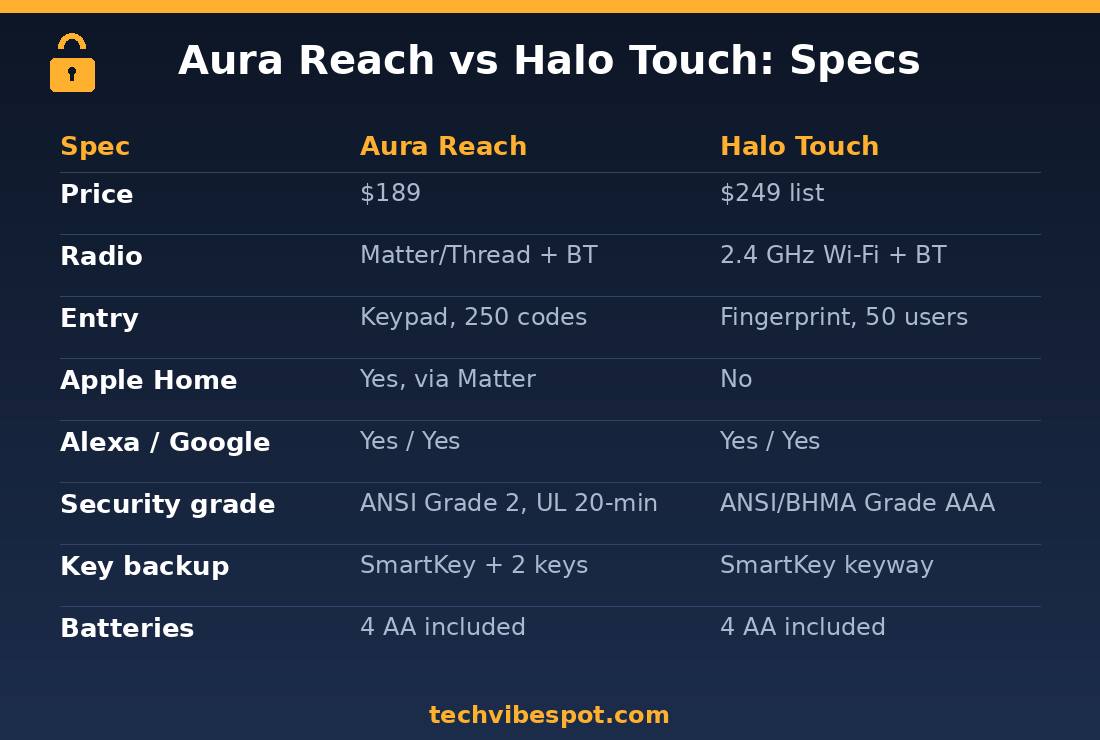
| Kwikset Aura Reach | $189 | Matter over Thread + Bluetooth (no Wi-Fi) | Yes, SmartKey + 2 keys | Apple Home / Matter households that want a keypad | Check price |
| Kwikset Halo Touch | $249 list, ~$220–$250 street | 2.4 GHz Wi-Fi + Bluetooth (no Matter) | Yes, SmartKey keyway | Fingerprint entry with zero extra hardware | Check price |
| TEEHO TE001 (budget) | Under $50 | None (standalone keypad) | Yes, 2 keys | Rentals and back doors that just need codes | Check price |
Other numbers worth knowing. The Aura Reach measures 5-13/16″ tall on the exterior and fits doors 1-3/8″ to 2-1/4″ thick, with an ANSI Grade 2 rating and a UL 20-minute fire rating, per Kwikset’s spec sheet. The Halo Touch’s exterior is smaller at 3-9/16″ tall, fits 1-3/4″ to 2″ doors, and carries Kwikset’s ANSI/BHMA Grade AAA certification for residential security, durability, and finish, per its product page. Prices checked July 24, 2026.
Which lock has better smart home connectivity, Matter or Wi-Fi?
The Aura Reach wins connectivity for 2026 and beyond, with one honest caveat: it needs a Thread border router for remote access. Because the lock has no Wi-Fi radio, controlling it from outside Bluetooth range requires a Matter controller with Thread on your network. That sounds like a hidden cost, but most smart speakers sold in the last few years already qualify: an Amazon Echo (4th gen or later), an Apple HomePod or HomePod mini, an Apple TV 4K, or a Google Nest Hub (2nd gen). PCWorld’s coverage notes Kwikset even added a Signal Range Boost setting that doubles the Thread radio’s output for homes where the border router sits far from the front door.
The payoff for that architecture: the Aura Reach works with Apple Home, Amazon Alexa, Google Home, and Samsung SmartThings simultaneously, and Thread draws meaningfully less battery power than a Wi-Fi radio that phones home to your router all day. It also joins Matter automations directly, so a single “Good night” scene can lock the door, kill the lights, and arm your cameras across brands.
The Halo Touch takes the older, simpler route: it connects straight to your 2.4 GHz Wi-Fi network. No hub, no border router, nothing else to buy. If you own zero smart speakers, that genuinely matters, because the Halo Touch gives you remote lock control and alerts with just the Kwikset app and your router. The cost is ecosystem reach. The Halo Touch works with Alexa and Google Assistant only. There is no Apple Home support, no Matter path, and Kwikset has shown no sign of retrofitting one onto a 2020-era platform. And per SafeHome.org’s review, changing your Wi-Fi network requires a full factory reset of the lock, an annoyance worth knowing about before you upgrade your router.
Does the Kwikset Aura Reach work with Apple Home?
Yes. The Aura Reach works with Apple Home through Matter over Thread, and that alone decides this comparison for iPhone households. Add it to the Home app, and you can lock or unlock with Siri, check status from the lock screen, and build automations alongside your other HomeKit devices. MacRumors’ CES coverage confirms Apple Home and Siri control out of the box, with a HomePod or Apple TV acting as the Thread border router.
Two limits to be clear about. First, the Aura Reach has no NFC chip, so it does not support Apple Home Key, the tap-your-iPhone-on-the-lock trick. You unlock via keypad, app, Siri, or its Bluetooth-based hands-free auto-unlock when you arrive home. Second, there’s no fingerprint reader; if biometrics are the whole point for you, this lock isn’t your answer. For tap-to-unlock or UWB approach detection you’re shopping a different price tier entirely; our guide to the best UWB smart locks of 2026 covers those.
The Halo Touch, again, offers no Apple integration of any kind. iPhone owners can still use the Kwikset app, but nothing surfaces in Apple Home. In a comparison between these two Kwikset locks, Apple users have exactly one choice, and it’s the cheaper one. That doesn’t happen often.
Fingerprint or keypad: how do you actually get in the door?
Daily entry is where the Halo Touch earns its price premium. Press a registered finger on the sensor and the deadbolt motors open in about a second, gloves-off caveats aside. It stores up to 100 fingerprints across 50 users, and you enroll, disable, or delete prints from the app. For households with kids who forget codes, or anyone whose hands are usually full, a good fingerprint reader beats a keypad every single day. SafeHome.org rated the lock 8.5/10 and called the sensor reliable for enrolled users.
The catch nobody mentions in the marketing: fingerprints must be enrolled in person, at the door. You cannot text a fingerprint to a house guest the way you text a code. For an Airbnb or a rental, that’s disqualifying; a keypad lock, where you generate a temporary code remotely and revoke it after checkout, is the right tool. That’s exactly the workflow the Aura Reach handles with its 250 scheduled or temporary codes, which is why keypad locks dominate our smart lock picks for Airbnb hosts.
The Aura Reach’s keypad is a backlit capacitive touchpad with a fingerprint-resistant matte coating, and it wakes on approach so you’re not slapping a dark panel at night. It also does one-touch locking: tap anywhere on the pad on your way out and the bolt throws. Both locks also unlock from the app, and both fall back to a physical key, so a dead battery never strands you on the porch. Neither lock senses whether the door is open or closed, so auto-lock on both is a timer, not a door-aware system. Leave the door ajar and either lock will happily throw the bolt into open air.
Which lock is more secure, Grade 2 or Grade AAA?
On paper the Halo Touch holds the stronger certification, and the honest answer is that the difference is smaller than the letters suggest. Kwikset certifies the Halo Touch to ANSI/BHMA Grade AAA, the highest residential rating across security, durability, and finish. The Aura Reach spec sheet lists ANSI Grade 2 plus a UL 20-minute fire rating. Grade 2 is the standard for quality residential deadbolts; Grade AAA (the residential-scheme equivalent of Grade 1 territory) adds margin in bolt strength and cycle testing.
Both locks use the same SmartKey Security cylinder, which is the more practical security story. SmartKey resists lock bumping and gives you self-service rekeying: turn the working key, insert the reset tool, insert a new key, done in under a minute. Lost keys stop being a locksmith bill. Both locks also alert you in the app after repeated invalid attempts (wrong codes on the Aura Reach, with tamper alerts built in) and log every entry with a timestamp, so you know which kid got home at 3:47.
One genuine security gap on the Halo Touch, flagged by SafeHome.org: the lock generates no alert when an unregistered fingerprint tries the sensor. Someone can probe your door and the app stays silent. The Aura Reach, by contrast, notifies on invalid code attempts. Neither issue is a dealbreaker, and neither lock has been the subject of a notable exploit, but the newer lock’s alerting is the more complete of the two. If maximum burglary resistance is your entire buying criterion, look past both of these at a Grade 1 commercial-style deadbolt and skip the electronics.
What about batteries, power, and reliability?
Both locks run on 4 AA batteries, included in the box, hiding under the interior cover. The architecture difference matters here more than the battery count. Thread is a low-power mesh protocol designed for battery devices; Wi-Fi is not. A deadbolt that keeps a 2.4 GHz Wi-Fi connection alive drains cells noticeably faster than one that whispers over Thread to a border router. Kwikset doesn’t publish an official month figure for either lock, and real-world life depends on how often the bolt cycles and how cold your winters get, but the physics favor the Aura Reach, and Wi-Fi locks as a class are the segment’s battery complainers.
Owner-reported friction points differ by model. For the Halo Touch, the recurring themes across retailer reviews and SafeHome’s assessment: app response can lag several seconds, the interior assembly is bulky at nearly 10 inches, and the Wi-Fi reset process means a factory reset. Kwikset’s broader Halo Wi-Fi line has a documented pattern of connection drops on congested 2.4 GHz networks; if you go the Halo route, give your router’s 2.4 GHz band a fighting chance near the door. For the Aura Reach, the model is barely six months old, so long-term owner data is thin. Early coverage flags only the Thread-range question, which the Signal Range Boost setting exists to address, and the absence of Home Key and a door sensor against pricier rivals.
Cold-weather performance is a wash: both are exterior-rated deadbolts with electronics on the inside face, and both list standard residential operating ranges. Alkaline AAs are the weak point in a deep freeze regardless of brand, so northern buyers should budget for lithium AAs each winter.
Is the Aura Reach’s newer platform worth giving up Wi-Fi?
For most buyers, yes. The things Wi-Fi gets you on the Halo Touch (remote control, alerts, voice assistants) the Aura Reach also delivers once a border router is on the network, and the border router is usually a speaker you already own. What Matter adds on top is portability: switch from Alexa to Apple Home in 2027 and the Aura Reach comes with you; the Halo Touch stays behind. Kwikset itself calls the Aura Reach its next-generation connected deadbolt, and at $189 it undercuts the lock it functionally replaces.
The case for the Halo Touch’s approach is narrower but real. No smart speakers and no plans to buy one? The Halo Touch is self-sufficient; the Aura Reach without a border router is Bluetooth-range-only, meaning no remote unlock for the dog walker while you’re at the office. Households that specifically want biometrics have no decision to make at all, since only one of these locks reads fingerprints. If that’s you but the Halo Touch’s price stings, Kwikset’s newer Halo Select Plus pairs Wi-Fi with Matter and adds door-position sensing, an option worth cross-shopping if you want a hedge, and our full Aura Reach review breaks down where each Kwikset tier lands.
Should you just buy a cheaper keypad lock instead?
If everything above sounds like more lock than you need, the honest answer is that a $40–$90 standalone keypad deadbolt covers pure keyless entry. The TEEHO TE001 (linked in the table above) is the one we point budget buyers to: auto-lock, up to 20 codes, one-touch locking, and a physical key backup, typically under $50. No app, no remote access, no voice control, and no entry log, which is precisely the trade. We’ve compared the TEEHO TE001 against the Wyze Lock Bolt if fingerprint-on-a-budget interests you, and our roundup of the best smart locks under $100 covers the middle ground where app control appears around the $70 mark.
The rule of thumb: buy the cheap lock for a back door, a garage entry door, or a rental where codes are the whole job. Buy the Aura Reach or Halo Touch for the front door of a home you own, where the entry log, guest scheduling, voice control, and smart home automations get used weekly instead of never.
Verdict: which Kwikset lock should you buy?
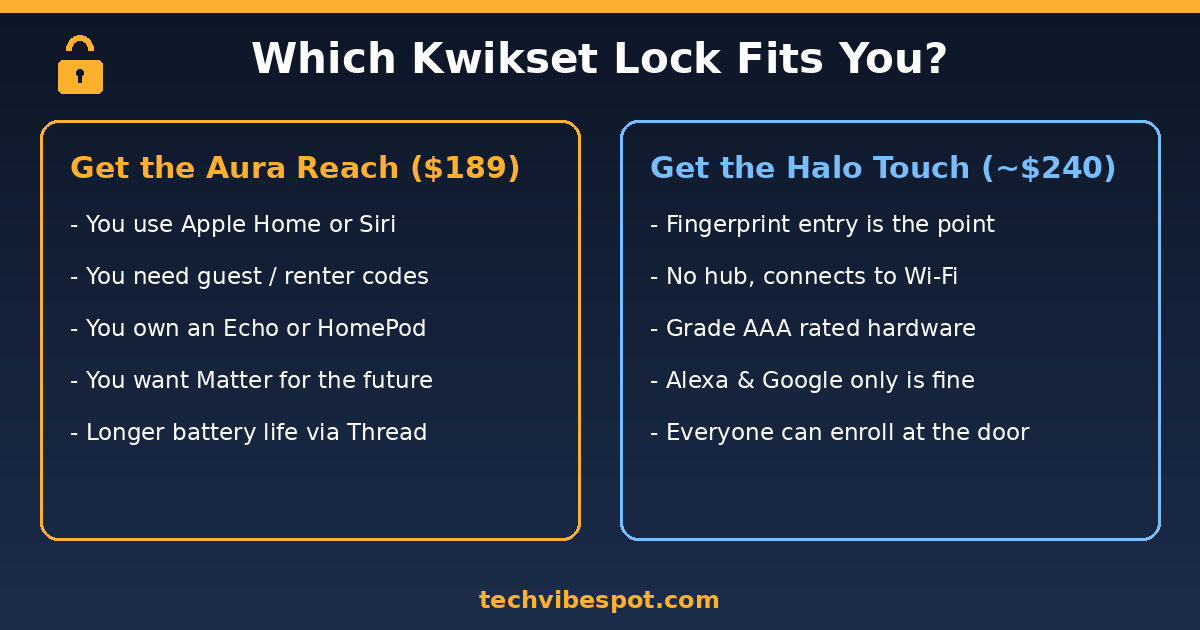
Buy the Kwikset Aura Reach if: you use Apple Home at all (it’s the only option here); you own any recent Echo, HomePod, Nest Hub, or Apple TV to act as a border router; you host guests or renters and need temporary codes; you want the longer-lived platform for the money. At $189 it’s the better lock for roughly 8 in 10 buyers reading this page.
Skip the Aura Reach if: you refuse to put a border router on your network, or you need Apple Home Key tap-to-unlock, which it can’t do.
Buy the Kwikset Halo Touch if: fingerprint entry is the feature you’re actually shopping for, and everyone who needs access can enroll at the door. It remains one of the few fingerprint deadbolts from a major American lock brand, and its Grade AAA hardware is excellent.
Skip the Halo Touch if: you’re in the Apple ecosystem, you rent the place out, or your 2.4 GHz Wi-Fi near the front door is already flaky.
The Aura Reach is the pick. It costs less, speaks every major smart home language including Apple’s, handles guest access the way modern households need, and sits on the protocol the entire industry is standardizing on. The Halo Touch is a specialist: the right answer to exactly one question, “do you want to open your door with a fingerprint?”, and the wrong answer to most others in 2026.
Check the Aura Reach price on Amazon →
Prices checked July 24, 2026. Both locks come in satin nickel and matte black; the Halo Touch adds Venetian bronze in its Traditional trim.
Frequently asked questions
Does the Kwikset Aura Reach have a fingerprint reader?
No. The Aura Reach uses a backlit touch keypad with up to 250 user codes, plus app, voice, and hands-free Bluetooth auto-unlock. If you want fingerprint entry from Kwikset, the Halo Touch is the model that has it.
Does the Kwikset Halo Touch work with Apple Home or Matter?
No. The Halo Touch connects over 2.4 GHz Wi-Fi and supports Amazon Alexa and Google Assistant only. It has no Matter, Thread, or Apple Home support, and Kwikset has not announced a Matter update for it.
Do I need a hub for the Kwikset Aura Reach?
For remote access, yes: a Thread border router such as a HomePod, Apple TV 4K, recent Amazon Echo, or Nest Hub (2nd gen). Without one, the lock still works fully at the door and over Bluetooth, but you can’t control it away from home.
Does the Aura Reach support Apple Home Key?
No. The Aura Reach lacks the NFC hardware Apple Home Key requires, so you can’t tap an iPhone or Apple Watch to unlock. It supports Siri voice control and Apple Home app control through Matter instead.
How many users can each lock store?
The Aura Reach stores up to 250 access codes. The Halo Touch stores up to 100 fingerprints across 50 users. Both let you add, schedule, and revoke access from the Kwikset app.
Can I rekey the Aura Reach or Halo Touch myself?
Yes. Both use Kwikset’s SmartKey Security cylinder, which lets you rekey the lock yourself in under a minute with the included reset tool, no locksmith required. Both also keep a physical key backup.
Do these locks still work if the internet goes down?
Yes. Codes on the Aura Reach and fingerprints on the Halo Touch are stored in the lock and work with no connection at all. You only lose remote control and notifications until the network returns.
Which lock has better battery life?
Both run on 4 AA batteries, but the Aura Reach’s Thread radio draws less power than the Halo Touch’s always-on Wi-Fi connection, so expect longer life from the Aura Reach under similar use. Cold climates shorten both; lithium AAs help.